
Save as PDF or print — the answers and worked solutions live online, where your work gets marked free.
Examinations Council of Zambia — past paper
ECZ 2011 O-Level Paper 2 — Mathematics
12 questions · downloaded from g12titan.com, where this paper is marked free online

1.
(a)
Evaluate 3 14 ÷ 5 15. [1]
(b)
Simplify 90 × 0.320.016 × 4.5. [2]
(c)
Express 25 + 14 ÷ 13 as a percentage. [3]
(d)
Factorise completely 3x2 - 3. [2]
2.
(a)
Express x + 23 - 2x - 34 as a single fraction in its simplest form. [3]
(b)
Given that matrix A = 1x-12,
(b(i))
write an expression in terms of x, for the determinant of A, [1]
(b(ii))
find the value of x, given that the determinant of A is 5, [2]
(b(iii))
write A-1. [1]
(c)
Solve the equation 12x + 2 = 35. [2]
3.
(a)
In the diagram below, the diagonals of the cyclic quadrilateral ABCD meet at E, O is the centre of the circle.
Given that angle DAB = 75° and angle DAC = 30°, calculate
(a(i))
angle BAC, [1]
(a(ii))
angle BCD, [1]
(a(iii))
angle OBD, [2]
(a(iv))
angle OBC. [1]
(b)
The cost of baking a birthday cake is K48 000.
(b(i))
Ireen has an order for 15 such cakes. How much did she spend on baking the cakes? [1]
(b(ii))
Given that each cake was sold at K57 600, find the percentage profit. [2]
(c)
Solve the inequation 7 - 2t < 9. [2]
4.
(a(i))
Construct parallelogram ABCD in which AB = 8 cm, BC = 5.3 cm and angle ABC = 60°. [1]
(a(ii))
Construct a perpendicular from A to meet CD at point Q and write down the length of AQ. [2]
(b)
On your diagram, draw the locus of points within the parallelogram ABCD which are
(b(i))
2.5 cm from AB, [1]
(b(ii))
3 cm from C, [1]
(b(iii))
equidistant from BC and CD. [1]
(c)
P is a point inside parallelogram ABCD such that P is:
nearer to BC than CD,
less than or equal to 3 cm from C,
less than or equal to 2.5 cm from AB.
Indicate clearly, by shading, the region in which P must lie. [2]
5.
(a)
A box contains 3 green apples and 5 red apples. An apple is picked from the box and not replaced then a second apple is picked. Expressing the answer as a fraction in its simplest form, calculate
(a(i))
the probability that both apples picked are green, [2]
(a(ii))
the probability that the two apples picked are of different colours. [3]
(b)
Solve the equation (2x - 1)(3x - 2) = 3, giving your answers correct to 2 decimal places. [6]
6.
(a)
The diagram below shows Mr Mayanda's piece of land for building a house. A, B and C are on level ground as shown below. B is due south of C and due east of A.
Given that AC = 100 m and BC = 60 m, calculate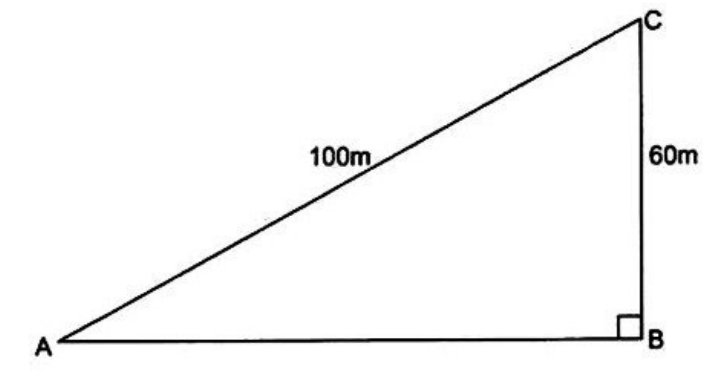
(a(i))
the length of AB. [2]
(a(ii))
the angle BAC. [2]
(b)
Simplify 3x - 4y - 2(x - 4y) - 2y. [2]
7.
(a)
The shaded part of the diagram below is that of a path of a car windscreen wiper. The wiper rotates through 120° about O. (Take π to be 227)
Given that OA = OB = 30 cm, AC = BD = 40 cm, calculate
(a(i))
the perimeter of the sector OCD correct to 1 decimal place, [3]
(a(ii))
the area of the shaded region correct to 1 decimal place. [3]
(b)
P and Q are points on the surface of the earth situated on the same parallel of latitude 70° N as shown below. The longitudes of P and Q are 25° W and 15° E respectively. A and B are two points on the equator such that A is due south of P and B is due south of Q.
(π = 3.142, R = 3437 nm)
(b(i))
State the position of the point Q. [1]
(b(ii))
Find the distance between A and B. [2]
(b(iii))
Calculate the circumference of the small circle at 70°N. [1]
(b(iv))
Find the distance along the parallel of latitude between P and Q, correct to 2 decimal places. [2]
8.
(a)
The diagram below is a trapezium OABC. M is the midpoint of AB, OM and CA meet at X. OA = 4p, OC = 2q and CB = 2p.
(a(i))
Express as simply as possible, in terms of p and/or q
(a(i)(a))
CA, [1]
(a(i)(b))
BA, [1]
(a(i)(c))
OM. [1]
(a(ii))
Given that CX = hCA, express CX in terms of p, q and h. [1]
(a(iii))
Hence, show that OX = 4hp + 2(1 - h)q. [2]
(b)
The variables x and y are connected by the equation y = 6 + 3x - 2x2. Some corresponding values of x and y are given in the table below. x-2-1012345y-81674-3-14p
(b(i))
Calculate the value of p. [1]
(b(ii))
Using a scale of 2 cm to represent 1 unit on the x-axis and 2 cm to represent 5 units on the y-axis for -2 ≤ x ≤ 5 and -30 ≤ y ≤ 10, draw the graph of y = 6 + 3x - 2x2. [3]
(b(iii))
Showing your method clearly, use your graph to solve the equation -2x2 + 3x = -2. [2]
9.
Study the diagram below and answer the questions that follow.
(a)
Triangle M is mapped onto triangle R by a translation. Write the translation vector. [1]
(b)
Triangle N is mapped onto shaded triangle T by a single transformation. Describe this transformation fully. [2]
(c)
An enlargement maps triangle M onto triangle N. Find
(c(i))
the centre of enlargement, [1]
(c(ii))
the scale factor. [2]
(d)
Shaded triangle P is mapped onto triangle Q with vertices (2, -1), (4, -4) and (4, -5) by a single transformation. Describe this transformation fully. [3]
(e)
Shaded triangle T is mapped onto triangle U with vertices (0, 5), (5, 5) and (5, 1) by a stretch. Find the matrix of this transformation. [3]
10.
The table below shows the masses of 100 babies at birth, recorded at a hospital. Mass x kg1.5 < x ≤ 2.02.0 < x ≤ 2.52.5 < x ≤ 3.03.0 < x ≤ 3.53.5 < x ≤ 4.04.0 < x ≤ 4.54.5 < x ≤ 5.0Number of babies312202425142
(a)
Copy and complete the cumulative frequency table below. Mass x kg≤1.5≤2.0≤2.5≤3.0≤3.5≤4.0≤4.5≤5.0Frequency0315100 [2]
(b)
Using a horizontal scale of 2 cm to represent 0.5 kg for masses from 1.5 kg to 5.0 kg and a vertical scale of 2 cm to represent 10 babies, draw a smooth cumulative frequency curve. [3]
(c)
Showing your method clearly, use your graph to estimate
(c(i))
the median mass, [1]
(c(ii))
the interquartile range, [2]
(c(iii))
the 40th percentile. [1]
(d)
How many babies weighed more than 4.3 kg? [3]
11.
(a)
Three candidates A, B and C took part in a student's union presidential elections. Candidate A received 12 600 votes and candidates B and C followed each other respectively.
(a(i))
Given that the ratio of the votes of candidate A to that of Candidate B is 3:2, calculate the number of votes received by Candidate B, [2]
(a(ii))
Given also that candidate B received 600 more votes than candidate C, calculate the number of votes for candidate C. [2]
(b)
A Girls' High School has been built in such a way that the Administration block (A), dormitories (B) and classes (C) are connected by straight corridors. A is 60 m from C and 130 m from B. The bearing of B from A is 110° and the bearing of A from C is 030° as shown below.
(b(i))
Find angle BAC. [1]
(b(ii))
Calculate the distance BC. [5]
(b(iii))
The Administration decided to build a tuckshop at a point T along BC such that T is the shortest distance from A. Given that the area of triangle ABC is 3 840.75 m2, calculate AT. [2]
12.
(a)
A small scale farmer wishes to keep sheep and goats. Let x represent the number of sheep and y represent the number of goats.
(a(i))
Write the inequalities which represent each of the following conditions:
(a(i)(a))
The number of sheep should not be more than 4. [1]
(a(i)(b))
A goat feeds on 4 kg of food while a sheep feeds on 2 kg of food per day. The total amount of food should be at least 8 kg per day. [2]
(a(i)(c))
The number of sheep should be more than the number of goats. [1]
(a(ii))
Using a scale of 2 cm to represent 1 unit on both axes, draw the x and y axes for 0 ≤ x ≤ 5 and 0 ≤ y ≤ 5 and shade the unwanted region to indicate clearly the region where the solution of the inequalities lies. [3]
(b)
In a certain month, a survey was conducted on 250 High School pupils to find out the number that bought oranges (O), mangoes (M) and lemons (L). Their responses were as shown in the Venn diagram below.
(b(i))
Find the value of x. [2]
(b(ii))
How many pupils bought Mangoes and Lemons but not Oranges? [2]
(b(iii))
How many pupils bought one type of fruit only? [1]