
Save as PDF or print — the answers and worked solutions live online, where your work gets marked free.
Examinations Council of Zambia — past paper
ECZ 2013 O-Level Paper 2 — Mathematics
12 questions · downloaded from g12titan.com, where this paper is marked free online

1.
(a)
Evaluate 2 58 - 2 16 ÷ 1 112. [2]
(b)
Express 0.041 as a percentage. [1]
(c)
Factorise completely 3y2 - 12. [2]
(d)
Mrs Maketiya sold a pair of shoes at K220.00. She made a profit of 10%. Calculate the cost of the shoes. [3]
2.
(a)
In the diagram below, a circle with centre O passes through the points P, Q, R and S. MRN is a tangent to the circle at R. PR = RQ, PS = SR and PR = 5 cm.
Find
(a(i))
angle PRQ, [1]
(a(ii))
angle RSP, [1]
(a(iii))
angle QRM, [1]
(a(iv))
angle SRN, [2]
(a(v))
the length of PQ correct to 3 decimal places. [2]
(b)
Express 2ax - 1 - ax - 2 as a single fraction in its simplest form. [3]
3.
(a)
Solve the equation x2 + 6x = -2, giving your answers correct to 2 decimal places. [5]
(b)
Given that A = 22-1, P = -1-14220 and Q = 2-141, find
(b(i))
-2P, [1]
(b(ii))
the determinant of Q, [1]
(b(iii))
AP. [2]
4.
(a)
The diagram below shows three sets A, B and C.
Given that n(A ∪ B ∪ C) = 50, find
(a(i))
the value of x, [2]
(a(ii))
n(A ∪ B), [1]
(a(iii))
n(B ∪ C)', [1]
(a(iv))
n(A' ∩ C'). [2]
(b)
Solve -5x - 9 ≤ 16. [2]
5.
(a)
In triangle OPR below, the line OX produced, meets PR at Y. PQ and OY meet at X such that XQ = (13)PQ. OP = p, OQ = q and OQ = QR.
(a(i))
Express each of the following as simply as possible in terms of p and/or q
(a(i)(a))
PQ, [1]
(a(i)(b))
OX. [2]
(a(ii))
Given that OY = hOX, show that PY = ((13)h - 1)p + (23)hq. [2]
(b)
Three liquids A, B and C are mixed in the ratio 1 : 2 : 3 to make a solution called elixir. Given that liquid B is 72 litres, find
(b(i))
the total number of litres for the solution elixir, [2]
(b(ii))
the difference in litres between liquid A and liquid B. [2]
6.
(a)
Construct a quadrilateral KFML in which KL = 8 cm, KF = 4 cm, LM = 9 cm, angle FKL = 62° and angle KLM = 118°. Measure and write the length FM. [2]
(b)
Inside the quadrilateral KFML, draw the locus of points which are:
(b(i))
4 cm from L, [1]
(b(ii))
3 cm from KL, [1]
(b(iii))
equidistant from MF and ML. [1]
(c)
Given that P is a point inside the quadrilateral such that it is 4 cm from L, more than 3 cm from KL and equidistant from MF and ML, label point P. [1]
(d)
Another point Q inside the quadrilateral is such that it is more than 3 cm from KL, less than 4 cm from L and nearer to MF than to ML. Indicate, by shading, the region in which Q must lie. [2]
7.
(a)
The diagram shows the graph of y = 2 + x - x2.
(a(i))
Use the graph to find the solutions of the equations
(a(i)(a))
0 = 2 + x - x2, [2]
(a(i)(b))
x - x2 = -1. [2]
(a(ii))
Calculate an estimate of
(a(ii)(a))
the gradient of the curve at the point (1, 2), [2]
(a(ii)(b))
the area bounded by the curve, y = 1, x = 0 and x = 1. [3]
(b)
Solve 3(x5 - 4) = 6 - 3x. [3]
8.
Triangle S has vertices (1, 1), (2, 1) and (1, 2) while triangle R has vertices (2, 3), (3, 3) and (2, 4).
(a)
Using a scale of 2 cm to represent 1 unit on each axis, draw axes for values of x and y in the range -5 ≤ x ≤ 5 and -5 ≤ y ≤ 4. Draw and label triangles S and R. [2]
(b)
Describe fully a single transformation that maps triangle S onto triangle R. [2]
(c(i))
Triangle T has vertices (-2, -2), (-4, -2) and (-2, -4). Draw and label triangle T. [1]
(c(ii))
Write the matrix of the transformation that maps triangle S onto triangle T. [3]
(d)
Triangle S is mapped onto triangle W with vertices (3, 1), (4, 1) and (5, 2). Draw triangle W and describe this transformation fully. [4]
9.
(a)
Mr Kafola earns a monthly salary of K2 500.00. The employer gives him a 10 12 % increase. How much more does he earn? [2]
(b)
M, T and R are Food Reserve Agency Maize buying points in a given district. T is 32 km from M on a bearing of 060° and R is 27 km from M on a bearing of 130° as shown in the diagram below.
Calculate
(b(i))
angle RMT, [1]
(b(ii))
the area of triangle MTR, [2]
(b(iii))
RT to the nearest kilometre, [5]
(b(iv))
MS, given that there is a shopping centre S along RT such that MS is the shortest distance from M. [2]
10.
(a)
A farmer wants to buy some hoes and shovels for use at his farm. He decides to buy at least 5 hoes and not more than 14 hoes and shovels altogether. The number of hoes should not be more than twice the number of shovels.
(a(i))
Taking x to represent the number of hoes and y the number of shovels, write three inequalities which satisfy the above conditions. [3]
(a(ii))
The point (x, y) represents x hoes and y shovels. Using a scale of 1 cm to represent 1 unit on both axes, draw the x and y axes for -1 ≤ x ≤ 15 and -1 ≤ y ≤ 15 and shade the unwanted region to indicate clearly the region where (x, y) must lie. [3]
(a(iii))
Find the largest number of shovels that can be bought. [1]
(b)
Kapofu bought three oranges and two apples which she put in a bag. Later on she picked one fruit at random from the bag and ate it. After some time she picked another fruit at random and ate it.
(b(i))
Construct a tree diagram to represent this information. [2]
(b(ii))
Hence or otherwise, find the probability that the two fruits picked were of different types. [3]
11.
(a)
M, R and Z are points on the surface of the earth as shown in the diagram below. M is on the parallel of latitude 55° N, Z and R are on the same parallel of latitude 65° S, M and R are on the same longitude 30° E and Z is on longitude 45° W [π = 3.142, R = 6 370 km].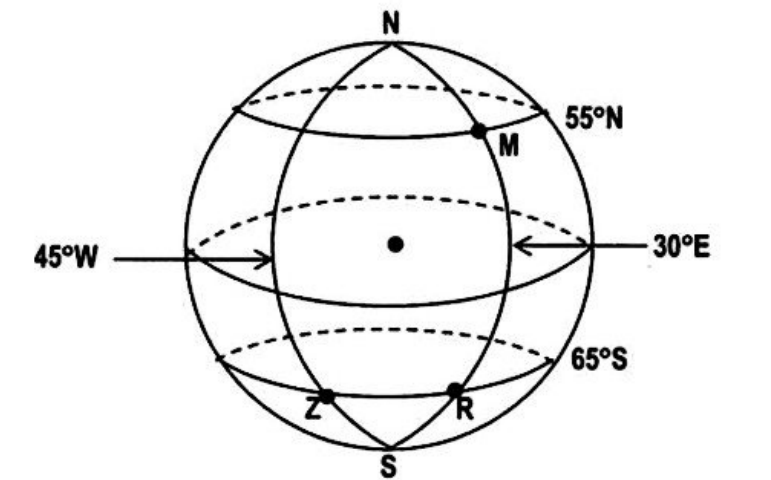
(a(i))
Find the difference in latitude between points M and R. [1]
(a(ii))
Calculate the distance MR along the same longitude, giving your answer to the nearest kilometre. [2]
(a(iii))
If the local time at Z is 08 00 hours, what is the time at R? [1]
(a(iv))
Find the distance ZR in kilometres, along the same latitude, giving your answer to the nearest kilometre. [2]
(b)
The diagram below shows part of a flag of an organisation which is in a form of a sector PQR. The circle centre O inside the sector is of radius 30 cm.
Given that PQ = PR = 1.26 m, angle RPQ = 40° and taking π = 3.142, calculate
(b(i))
the perimeter of sector PQR, [3]
(b(ii))
the area of the shaded part, giving your answer in square centimetres. [3]
12.
The table shows the number of litres of water that 80 pupils at Tapasa Primary School drank on two cold days. Litres of water x0 < x ≤ 0.50.5 < x ≤ 11 < x ≤ 1.51.5 < x ≤ 22 < x ≤ 2.52.5 < x ≤ 33 < x ≤ 3.53.5 < x ≤ 4Number of pupils22719301451
(a)
Calculate the estimated mean litres of water drank. [3]
(b)
Copy and complete the cumulative frequency distribution. Litres of water x≤0≤0.5≤1≤1.5≤2≤2.5≤3≤3.5≤4Frequency0241130 [2]
(c)
Using a horizontal scale of 4 cm to represent 1 litre of water on the x-axis and a vertical scale of 2 cm to represent 10 pupils on the y-axis, draw a smooth cumulative frequency curve. [3]
(d)
Showing your method clearly, use your graph to estimate
(d(i))
the median, [1]
(d(ii))
the interquartile range, [2]
(d(iii))
the 80th percentile. [1]