
Save as PDF or print — the answers and worked solutions live online, where your work gets marked free.
Examinations Council of Zambia — past paper
ECZ 2016 GCE Paper 2 — Mathematics
12 questions · downloaded from g12titan.com, where this paper is marked free online

1.
(a)
Factorise completely 4x2 - 16y2. [2]
(b)
Evaluate 2 12 + 34 ÷ 118. [2]
(c)
Express the value of 0.2 × 0.6 as a percentage. [2]
2.
(a)
Express 43r - 2 - 3r + 5 as a single fraction in its simplest form. [3]
(b)
Simplify 3a5c2 × 10c3/a2. [2]
(c)
Given that the determinant of matrix A = x - 2x21 is 4,
(c(i))
find the value of x, [2]
(c(ii))
write the inverse of the matrix A. [2]
3.
(a)
In the diagram below, ABDG is a circle with centre O.
Given that angle GBD = 21°, BC and CE are tangents to the circle at B and D respectively, calculate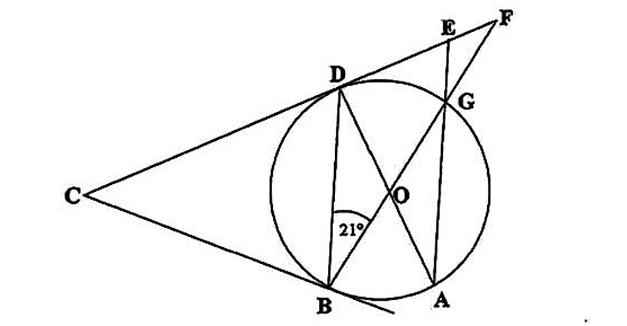
(a(i))
angle GOD, [1]
(a(ii))
angle GFE, [1]
(a(iii))
angle GED, [1]
(a(iv))
angle BCD. [2]
(b)
Solve the equation x2 + 2x = 5, giving your answers correct to 2 decimal places. [5]
4.
Answer the whole of this question on a sheet of plain paper.
(a)
Construct triangle PQR in which PQ = 10 cm, PR = 8.5 cm and QR = 9 cm. [1]
(b)
Measure and write the size of angle PRQ. [1]
(c)
On your diagram, draw the locus of points which are
(c(i))
5.5 cm from P, [1]
(c(ii))
equidistant from P and R, [1]
(c(iii))
equidistant from PR and PQ. [2]
(d)
A point S inside triangle PQR is such that S is:
less than or equal to 5.5 cm from P,
nearer to P than to R,
nearer to PR than to PQ.
Indicate clearly, by shading, the region in which S must lie. [2]
5.
(a)
The Venn diagram below shows the results of a survey conducted at Mayuka clinic on patients who were attended to on a particular day. Set W represents those who complained of body weakness, set H those who complained of headache and set F those who complained of fever.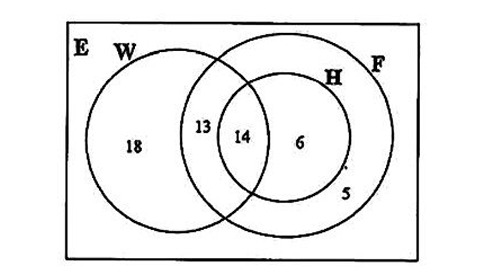
(a(i))
Use the information in the Venn diagram to find the number of people who complained of
(a(i)(a))
body weakness only, [1]
(a(i)(b))
body weakness and fever only, [1]
(a(i)(c))
headache. [1]
(a(ii))
Calculate the percentage of those who complained of all the three ailments. [2]
(b)
Solve the inequality (32)n + 5 < 14. [2]
(c)
Given that 4% of the bricks get damaged when they reach the building site, how many bricks should a builder order if 4 800 are needed to finish a job? [2]
6.
(a)
In the diagram below, OA = a and OB = b. C on AB is such that AC:CB = 2 : 1 and B on OD is such that OB : OD = 1 : 2.
Express as simply as possible in terms of a and/or b.
(a(i))
AB, [1]
(a(ii))
AD, [1]
(a(iii))
CD. [2]
(b)
Tickets for a variety show held at Movi Secondary School were sold at K50.00 each. Half of the money collected at the show was donated to charity. If the charity received K2 500.00, how many tickets were sold? [3]
(c)
72 ladies were invited to a kitchen party. The ratio of those who took Fanta to those who did not was 13 : 5 respectively. Given that 18 others came in uninvited and 8 of these took Fanta, find the new ratio of those who took Fanta to those who did not. [3]
7.
(a)
Three towns Luzi (L), Muzi (M) and Puzi (P) are spaced as shown in the diagram. M is on a bearing of 060° from L and P is on a bearing of 105° from M.
Given that M is 450 km from L and 600 km from P, calculate
(a(i))
the distance between L and P, [5]
(a(ii))
the area of triangle LMP, [3]
(a(iii))
angle MPL. [2]
(b)
In the figure below, O is the centre of the circle, the chord AB is perpendicular to OC and OC = 4.3 cm.
Given that the chord AB is 38.2 cm, calculate the radius of the circle. [2]
8.
Answer the whole of this question on a sheet of graph paper.
A farmer had 260 potatoes in a sack. The masses, in grams, of the potatoes are given in the table below.
Mass x grams100 < x ≤ 150150 < x ≤ 200200 < x ≤ 250250 < x ≤ 300300 < x ≤ 350350 < x ≤ 400No. of Potatoes15457580405
(a)
Calculate an estimate of the mean mass of the potatoes. [3]
(b(i))
Copy and complete the cumulative frequency table below.
Mass x grams≤ 100≤ 150≤ 200≤ 250≤ 300≤ 350≤ 400Cumulative frequency01560260 [1]
(b(ii))
Using a horizontal scale of 2 cm to represent 50 grams for masses between 0 and 400 grams and a vertical scale of 2 cm to represent 25 potatoes, draw a smooth cumulative frequency curve. [3]
(b(iii))
Use your graph to find
(b(iii)(a))
the median, [1]
(b(iii)(b))
the interquartile range. [2]
(c)
A potato is picked at random from the sack. What is the probability that it has a mass greater than 250 grams? [2]
9.
(a)
The region R in the diagram below shows the set of points (x, y) satisfying four inequalities representing the number of chairs (x) and tables (y) a carpenter made.
(a(i))
If two of the inequalities are y ≥ 20 and y ≥ 2x + 10, write the other two inequalities. [3]
(a(ii))
The carpenter makes a profit of K100.00 on a chair and K60.00 on a table sold. Given that the carpenter sold all the chairs and tables he made, find the
(a(ii)(a))
values of x and y which would give him maximum profit, [2]
(a(ii)(b))
maximum profit. [2]
(b)
A bag contains 3 black balls and 2 white balls. Two balls are taken from the bag at random, one after another, without replacement.
(b(i))
Draw a tree diagram to represent this information. [3]
(b(ii))
Calculate the probability that the two balls taken at random are of the same colour. [2]
10.
(a)
Answer the whole of this question on a sheet of graph paper.
The variables x and y are connected by the equation y = x2/5 + 2x.
Some corresponding values of x and y correct to 1 decimal place, where necessary, are given in the table below.
x0.30.611.523456y6.73.42.21.81.82.53.75.4q
(a(i))
Calculate the value of q, giving your answer correct to 1 decimal place. [1]
(a(ii))
Taking 2 cm to represent 1 unit on each axis, draw the x and y axes for 0 ≤ x ≤ 6 and 0 ≤ y ≤ 8. Draw the graph of y = x2/5 + 2x. [3]
(a(iii))
Use your graph to solve the equation x2/5 + 2x = 3. [2]
(a(iv)(a))
On the same axes, draw the graph of y = x + 72. [1]
(a(iv)(b))
Hence or otherwise, solve the equation x2/5 + 2x = x + 72. [2]
(b)
K480.00 is invested in an account which pays 10% per year compound interest. Find the total interest earned if money is left in the account for 3 years. [3]
11.
The diagram shows triangle A, B, C, E and F.
(a)
Describe fully a single transformation which maps triangle A onto triangle B. [2]
(b)
Triangle A is mapped onto triangle C by a rotation. Find
(b(i))
the angle and direction of this rotation, [2]
(b(ii))
the co-ordinates of the centre of rotation. [2]
(c)
Triangle A is mapped onto triangle F by an enlargement. Find the centre and scale factor of the enlargement. [2]
(d)
Triangle A is mapped onto triangle E by a shear. Find the invariant line and the matrix that represents this transformation. [4]
12.
(a)
The diagram below shows the cross-section of a circular metal disc of radius 14 mm. The disc has a central hole which is a square of side 4 mm. [π = 3.142]
(a(i))
Calculate the shaded area in mm2. [3]
(a(ii))
Given that the thickness of the disc is 5 mm, calculate in mm3 the amount of materials required to make 20 such discs. [3]
(b)
In the diagram below, A(65° N, 5° E), B(65° N, 45° W) and C are three points on the surface of the model of the earth and O is the centre of the model. The point C, due south of A, is such that angle AOC = 82°. [π = 3.142, R = 3 437 nm]
(b(i))
State the longitude of A. [1]
(b(ii))
Calculate the latitude of C. [1]
(b(iii))
Calculate, in nautical miles, the shortest distance
(b(iii)(a))
between A and C measured along the common longitude, [2]
(b(iii)(b))
between A and B measured along the circle of latitude. [2]