
Save as PDF or print — the answers and worked solutions live online, where your work gets marked free.
Examinations Council of Zambia — past paper
ECZ 2017 GCE Paper 1 — Mathematics
43 questions · downloaded from g12titan.com, where this paper is marked free online

1.
On the Venn diagram in the answer space below, shade the region defined by A'∩(B∪C).
- A

- B

- C

- D

2.
Given that E={1,2,3,4,5,6,7,8},A={1,8} and B={2,3,4,5,6,7}, list (A∪B)'.
- A{1,8}
- B{1,2,3,4,5,6,7,8}
- C∅
- D{2,3,4,5,6,7}
3.
Simplify 2a − 7b − 2(a − 3b).
- A−b
- Bb
- C−13b
- D4a − 13b
4.
Factorise completely x24y2 − 19.
- A(x2y − 13)2
- B(x2y − 13)(x2y + 13)
- C(x4y − 13)(x4y + 13)
- D(x2y − 19)(x2y + 19)
5.
Given that 2x-51 43 = 14-17, find the value of x.
- A6
- B2
- C−2
- D3
6.
Two tins are geometrically similar. If the ratio of their volumes is 27 : 64, find the ratio of their curved surface areas.
- A3 : 4
- B27 : 64
- C9 : 16
- D81 : 256
7.
Given that a = 3-4, find |a|.
- A5
- B7
- C25
- D1
8.
For the sequence 11, 13, 15, 17, …, find the 13th term.
- A37
- B33
- C24
- D35
9.
If the arithmetic mean of 5 and c is 11, what is the value of c?
- A17
- B6
- C27
- D8
10.
If AT = (1 −2 3 −4 5), write the matrix A.
- AThe row (1 −2 3 −4 5)
- BThe column [1; −2; 3; −4; 5]
- CThe column [5; −4; 3; −2; 1]
- DThe row (5 −4 3 −2 1)
11.
Find the derivative of y = 2x3 − 2x2 − 3x + 1, with respect to x.
- A6x2 − 4x − 3
- B6x3 − 4x2 − 3x
- Cx42 − 2x33 − 3x22 + x
- D6x2 − 2x − 3
12.
Solve the equation 25ˣ = 5.
- Ax = 2
- Bx = −12
- Cx = 5
- Dx = 12
13.
A soccer match kicked off at 14 00 hours at A(20°N, 30°E). What would be the kick off time of the soccer match at B(20°N, 15°W)?
- A17 00 hours
- B13 00 hours
- C11 00 hours
- D11 45 hours
14.
Two towns P and Q are on the same longitude. Given that P is (40°N, 15°W) and PQ is 7 200 nm, find the position of Q.
- A(80°N, 15°W)
- B(80°S, 15°W)
- C(60°S, 15°W)
- D(40°S, 15°W)
15.
A die and a coin are rolled and tossed, respectively. What is the probability of getting a five and a tail?
- A16
- B112
- C12
- D18
16.
Given that x = 3.2 × 34 and y = 4 × 32, evaluate xy.
- A0.8
- B72
- C7.2
- D2.4
17.
In the diagram below, points A, B, C and D are on a circle. BD is the diameter of the circle. AĈB = 42°, CÂD = 33° and the lines AC and BD intersect at X. Find CB̂D.
- A42°
- B24°
- C66°
- D33°
18.
In the same diagram (BD a diameter, AĈB = 42°, CÂD = 33°), find AĈD.
- A48°
- B33°
- C42°
- D57°
19.
In the same diagram (BD a diameter, AĈB = 42°, CÂD = 33°, AC and BD intersecting at X), find AX̂B.
- A75°
- B105°
- C90°
- D84°
20.
The functions g and f are defined as g : x → x − 12 and f : x → 3x − 5. Find g-1(x).
- Ax + 12
- B2x − 1
- C2x + 1
- D12x + 1
21.
With g : x → x − 12 and f : x → 3x − 5, find x if f(x) = g(x).
- A95
- B59
- C9
- D115
22.
With g : x → x − 12 and f : x → 3x − 5, find g-1f(x).
- A2x + 63
- B3x − 62
- C6x − 9
- D6x − 11
23.
y varies inversely as the square root of x, where x is positive. Write an expression for y in terms of x and the constant of variation k.
- Ay = k√x
- By = k/√x
- Cy = kx2
- Dy = √xk
24.
y varies inversely as the square root of x (y = k/√x). Given that y = 2 when x = 16, find the value of k.
- A12
- B32
- C8
- D2
25.
y varies inversely as the square root of x, with y = 8/√x. Find the value of a for which y = 89 when x = a.
- A9
- B3
- C81
- D729
26.
Maphone Manufacturing Company paid a total dividend of K12 600.00 at the end of 2015 on 6 000 shares. If Magula owned 200 shares in the company, how much was paid out in dividends to her?
- AK2.10
- BK63.00
- CK420.00
- DK210.00
27.
The diagram shows triangle ABC in which AC = 18 cm, CÂB = 30° and AB̂C = 90°. Calculate the length of BC.
- A15.6 cm
- B9 cm
- C36 cm
- D10.4 cm
28.
The curved surface area of a cone is 88 cm2. Given that the base radius is 4 cm, calculate the slant height of the cone. [π = 227, A = πrl]
- A3.5 cm
- B14 cm
- C22 cm
- D7 cm
29.
A flow chart computes tax on an income: Enter Income → Is Income < 3 000? If Yes, Tax = 0; if No, Tax = 0.3 × (Income − 3 000) → Output Tax. What tax does the program output for incomes of K2 900.00 and K5 000.00 respectively?
- AK870 and K1 500
- BK0 and K1 500
- CK870 and K600
- DK0 and K600
30.
A bag of potatoes has mass (15.4 ± 0.05) kg. Find the tolerance of this mass.
- A0.05 kg
- B0.1 kg
- C0.5 kg
- D0.025 kg
31.
A bag of potatoes has mass (15.4 ± 0.05) kg. Write down the relative error of the mass, as a fraction, in its simplest form.
- A1154
- B1616
- C1308
- D13080
32.
A, B and C are three points on level ground. B is on a bearing of 070° from A and C is on a bearing of 130° from B. Calculate the bearing of A from B.
- A110°
- B070°
- C290°
- D250°
33.
A, B and C are three points on level ground. B is on a bearing of 070° from A and C is on a bearing of 130° from B. Calculate the bearing of B from C.
- A050°
- B130°
- C310°
- D230°
34.
The diagram shows a regular hexagonal prism with an axis drawn through the centres of its two hexagonal faces. What is the order of rotational symmetry about the indicated axis?
- A2
- B12
- C8
- D6
35.
The diagram shows two triangles ABC and A′B′C′ on the XOY plane: A(−4½, 1½), B(−2, 3), C(−½, 1½) and A′(6½, 1½), B′(4, 3), C′(2½, 1½). Describe fully the single transformation that maps triangle ABC onto triangle A′B′C′.
- AA translation by [8; 0]
- BA reflection in the line x = 1
- CA rotation of 180° about (1, 0)
- DA reflection in the y-axis
36.
The diagram shows a Cartesian plane with points A(6, 6), B(0, −2), C(0, 6) and D(6, 0). Find the equation of the line CD.
- Ay = x + 6
- By = −x − 6
- Cy = x − 6
- Dy = −x + 6
37.
The diagram shows a Cartesian plane with points A(6, 6), B(0, −2), C(0, 6) and D(6, 0). Find the distance AB.
- A10
- B14
- C5.3
- D100
38.
Write the four inequalities that define the unshaded region R on the XOY plane: R is bounded by the solid horizontal lines y = 3 (above it, shading) and y = −1 (below it, shading), the dashed vertical line x = 2 (shading to its right), and the solid line through (−2, 0) and (0, 2) (shading to its upper left).
- Ay ≤ 3, y ≥ −1, x < 2, y ≤ x + 2
- By < 3, y > −1, x ≤ 2, y ≥ x + 2
- Cy ≤ 3, y ≤ −1, x < 2, y ≤ x + 2
- Dy ≥ 3, y ≤ −1, x > 2, y ≥ x + 2
39.
The diagram shows a sketch of the graph of y = x2 − 6x + 8, cutting the x-axis at B and C. Find the coordinates of B and C.
- AB(2, 0) and C(4, 0)
- BB(−2, 0) and C(−4, 0)
- CB(0, 2) and C(0, 4)
- DB(1, 0) and C(8, 0)
40.
The diagram shows a sketch of the graph of y = x2 − 6x + 8, cutting the x-axis at B(2, 0) and C(4, 0). Find the coordinates of the turning point of the graph.
- A(3, 1)
- B(3, −1)
- C(−3, −1)
- D(0, 8)
41.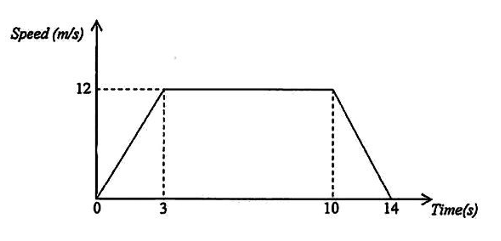
The diagram below shows the speed-time graph of a 100 m sprinter who accelerates uniformly for 3 seconds until he reaches a speed of 12 m/s. He maintains the speed for 7 seconds and then uniformly retards for a further 4 seconds and comes to a stop. Calculate the acceleration during the first 3 seconds.
- A3 m/s2
- B12 m/s2
- C4 m/s2
- D36 m/s2
42.
In the same race (12 m/s maintained until the 10th second, then uniform retardation to rest over the last 4 seconds), calculate the retardation at the end of his race.
- A4 m/s2
- B6 m/s2
- C12 m/s2
- D3 m/s2
43.
In the same race (0 to 12 m/s over 3 s, constant 12 m/s from the 3rd to the 10th second, rest at 14 s), calculate the distance he covered in the first 10 seconds.
- A120 m
- B84 m
- C102 m
- D51 m