
Save as PDF or print — the answers and worked solutions live online, where your work gets marked free.
Examinations Council of Zambia — past paper
ECZ 2017 O-Level Paper 2 — Mathematics
12 questions · downloaded from g12titan.com, where this paper is marked free online

1.
(a)
Given that matrix M = 3-25x,
(a(i))
find the value of x for which the determinant of M is 22, [2]
(a(ii))
hence find the inverse of M. [2]
(b)
A survey carried out at Kamulima Farming Block showed that 44 farmers planted maize, 32 planted sweet potatoes, 37 planted cassava, 14 planted both maize and sweet potatoes, 24 planted both sweet potatoes and cassava, 20 planted both maize and cassava, 9 planted all the three crops and 6 did not plant any of these crops.
(b(i))
Illustrate this information on a Venn diagram. [2]
(b(ii))
How many farmers
(b(ii)(a))
were at this farming block, [1]
(b(ii)(b))
planted maize only, [1]
(b(ii)(c))
planted 2 different crops? [1]
2.
(a)
A box of chalk contains 5 white, 4 blue and 3 yellow pieces of chalk. A piece of chalk is selected at random from the box and not replaced. A second piece of chalk is then selected.
(a(i))
Draw a tree diagram to show all the possible outcomes. [2]
(a(ii))
Find the probability of selecting pieces of chalk of the same colour. [3]
(b)
In the diagram below, OP = 2p, OQ = 4q and PX : XQ = 1 : 2.
(b(i))
Express in terms of p and/or q
(b(i)(a))
PQ, [1]
(b(i)(b))
PX, [1]
(b(i)(c))
OX. [1]
(b(ii))
Given that OC = hOX, show that CQ = 4(1 - h3)q - (4h3)p. [2]
3.
(a)
Construct a quadrilateral ABCD in which AB = 10 cm, angle ABC = 120°, angle BAD = 60°, BC = 7 cm and AD = 11 cm. [1]
(b)
Measure and write the length of CD. [1]
(c)
Within the quadrilateral ABCD, draw the locus of points which are
(c(i))
8 cm from A, [1]
(c(ii))
equidistant from BC and CD. [2]
(d)
A point P, within the quadrilateral ABCD, is such that it is 8 cm from A and equidistant from BC and CD. Label point P. [1]
(e)
Another point Q, within the quadrilateral ABCD, is such that it is nearer to CD than BC and greater than or equal to 8 cm from A. Indicate, by shading, the region in which Q must lie. [2]
4.
(a)
Solve the equation 2x2 = 6x + 3, giving your answers correct to 2 decimal places. [5]
(b)
The figure below is a frustum of a cone. The base diameter and top diameter are 42 cm and 14 cm respectively, while the height is 20 cm. (Take π as 3.142)
Calculate its volume. [6]
5.
(a)
For the geometric progression 20, 5, 1 14, ..., find
(a(i))
the common ratio, [2]
(a(ii))
the nth term, [2]
(a(iii))
the sum of the first 8 terms. [3]
(b)
Simplify 14x39y2 ÷ 7x418y3. [2]
6.
Study the flow chart below.
(a)
Write a pseudo code corresponding to the flow chart program above. [5]
7.
(a)
The diagram below shows the location of houses for a village Headman (H), his Secretary (S) and a Trustee (T). H is 1.3 km from S, T is 1.9 km from H and angle THS = 130°.
Calculate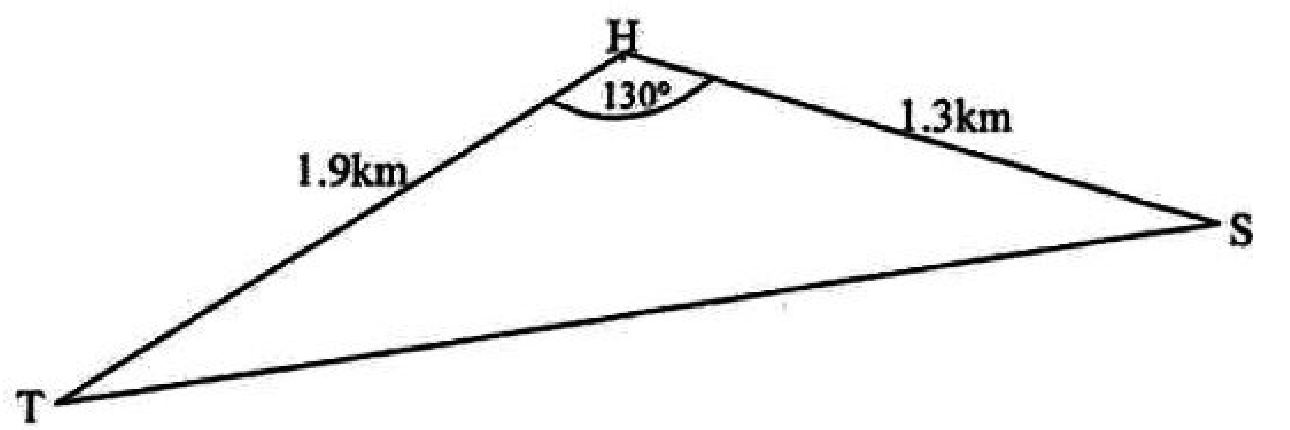
(a(i))
the area of triangle THS, [2]
(a(ii))
the distance TS, [5]
(a(iii))
the shortest distance from H to TS. [2]
(b)
Find the angle between 0° and 90° which satisfies the equation cos θ = 23. [1]
(c)
Simplify 2x2 - 8x + 2. [2]
8.
The table below shows the amount of money spent by 100 learners at school on a particular day. Amount in Kwacha0<x≤55<x≤1010<x≤1515<x≤2020<x≤2525<x≤30Frequency1327351672
(a)
Calculate the standard deviation. [6]
(b(i))
Using the table above, copy and complete the cumulative frequency table below. Amount in Kwacha≤0≤5≤10≤15≤20≤25≤30Frequency01340100 [1]
(b(ii))
Using a scale of 2 cm to represent 5 units on the horizontal axis and 2 cm to represent 10 units on the vertical axis, draw a smooth cumulative frequency curve. [3]
(b(iii))
Showing your method clearly, use your graph to estimate the semi-interquartile range. [2]
9.
(a)
W, X, Y and Z are four points on the surface of the earth as shown in the diagram below. (Take π as 3.142 and R = 3437 nm)
(a(i))
Calculate the difference in latitude between W and Y. [2]
(a(ii))
Calculate the distance in nautical miles between
(a(ii)(a))
X and Z along the longitude 105° E, [2]
(a(ii)(b))
Y and Z along the circle of latitude 30° S, [2]
(b)
Find the coordinates of the points on the curve y = 2x3 - 3x2 - 36x - 3 where the gradient is zero. [4]
(c)
Evaluate ∫3-1 (3x2 - 2x) dx. [2]
10.
(a)
The diagram below shows the graph of y = x3 + 3x2 - x - 3.
(a(i))
Use the graph to find the solutions of the equations
(a(i)(a))
x3 + 3x2 - x - 3 = 0, [2]
(a(i)(b))
x3 + 3x2 - x = 5. [2]
(a(ii))
Calculate an estimate of
(a(ii)(a))
the gradient of the curve at the point (-3, 0), [2]
(a(ii)(b))
the area bounded by the curve, x = 0, y = 0 and y = 20. [3]
(b)
Express 1x - 4 - 25x - 1 as a single fraction in its lowest terms. [3]
11.
Himakwebo orders maize and groundnuts for sale. The order price of a bag of maize is K75.00 and that of a bag of groundnuts is K150.00. He is prepared to spend up to K7 500.00 altogether. He intends to order at least 5 bags of maize and at least 10 bags of groundnuts. He does not want to order more than 70 bags altogether.
(a)
If x and y are the number of bags of maize and groundnuts respectively, write four inequalities which represent these conditions. [4]
(b)
Using a scale of 2 cm to represent 10 bags on each axis, draw the x and y axes for 0 ≤ x ≤ 70 and 0 ≤ y ≤ 70 respectively and shade the unwanted region to show clearly the region where the solution of the inequalities lie. [4]
(c)
Given that the profit on a bag of maize is K25.00 and on a bag of groundnuts is K50.00, how many bags of each type should he order to have maximum profit? [2]
(d)
What is this estimate of the maximum profit? [2]
12.
Using a scale of 1 cm to represent 1 unit on each axis, draw x and y axes for -6 ≤ x ≤ 10 and -10 ≤ y ≤ 8.
(a)
A quadrilateral ABCD has vertices A(-5, 7), B(-4, 8), C(-3, 7) and D(-4, 4) while its image has vertices A1(-5, -3), B1(-6, -2), C1(-5, -1) and D1(-2, -2).
(a(i))
Draw and label the quadrilateral ABCD and its image A1B1C1D1. [2]
(a(ii))
Describe fully the transformation which maps quadrilateral ABCD onto quadrilateral A1B1C1D1. [3]
(b)
The matrix -2001 maps the quadrilateral ABCD onto the quadrilateral A2B2C2D2.
(b(i))
Find the coordinates of the vertices of the quadrilateral A2B2C2D2. [2]
(b(ii))
Draw and label the quadrilateral A2B2C2D2. [1]
(c)
The quadrilateral ABCD is mapped onto the quadrilateral A3B3C3D3 where A3 is (4, -8), B3 is (2, -10), C3 is (0, -8) and D3 is (2, -2). Describe fully this transformation. [4]