
Save as PDF or print — the answers and worked solutions live online, where your work gets marked free.
Examinations Council of Zambia — past paper
ECZ 2018 O-Level Paper 1 — Mathematics
44 questions · downloaded from g12titan.com, where this paper is marked free online

1.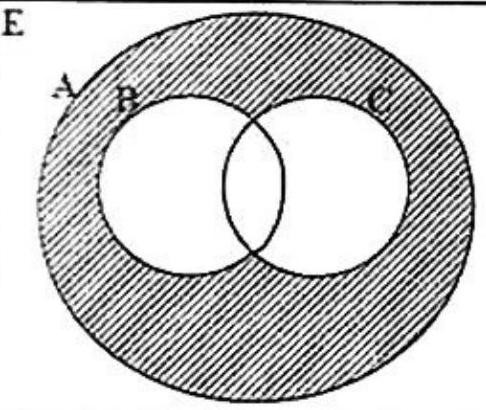
Use set notation to describe the shaded region in the diagram below.
- AA∩(B∪C)′
- BA∩(B∩C)′
- C(B∪C)′
- DA∪(B∪C)′
2.
The Venn diagram below shows sets A and B . List A'∩B.
- A{4}
- B{2,4,7,8}
- C{3,4,5,6}
- D{1,9}
3.
Find the value of x0 × 23.
- A23x
- B16
- C8
- D0
4.
Factorise completely 18 - 2x2.
- A2(x - 3)(x + 3)
- B(3 - x)(3 + x)
- C2(9 - x)(9 + x)
- D2(3 - x)(3 + x)
5.
Z is a point (-1, 8) and M is a point (2, 12). Find the magnitude of ZM.
- A7
- B25
- C√7
- D5
6.
Floyd had 125 shares in a company. At the end of a financial year, the company declared a dividend of K3.00 per share. How much was due to Floyd?
- AK375.00
- BK41.67
- CK128.00
- DK250.00
7.
A cylinder with diameter 2 cm has a volume of 5 cm3. Find the volume of a similar cylinder with diameter 8 cm.
- A20cm3
- B320cm3
- C80cm3
- D160cm3
8.
Express 140211324 -14522301-2 as a single matrix.
- A-116042302-8
- B712170111112013
- C712170101112013
- D701121120171113
9.
For an arithmetic progression 16, 25, 34, 43, 52, ........, write down the
(a) next term.
- A59
- B60
- C61
- D70
10.
For an arithmetic progression 16, 25, 34, 43, 52, ........, write down the
(b) nth term.
- A16n + 9
- B9n + 7
- C7n + 9
- D9n + 16
11.
A plane leaves a town P(0°, 30°W) and flies due East to a town Q(0°, 50°E) in 3 hours. The distance between P and Q is 4 800 nm.
(a) Calculate its average speed.
- A1 600 knots
- B14 400 knots
- C800 knots
- D1 200 knots
12.
A plane leaves a town P(0°, 30°W) and flies due East to a town Q(0°, 50°E) in 3 hours. The distance between P and Q is 4 800 nm.
(b) If the plane leaves P at 06 00 hours, what time will it arrive at Q?
- A14 20 hours
- B03 40 hours
- C11 20 hours
- D09 00 hours
13.
Given that matrix M = 3-10-2130-12, find MT.
- A3-10-2130-12
- B3-201-1-1032
- C30-2-11-1032
- D3-20-11-1032
14.
Expand and simplify (c + 3)2.
- A2c + 6
- Bc2 + 9
- Cc2 + 6c + 9
- Dc2 + 3c + 9
15.
A box contains 5 green, 3 yellow and 6 red beads of the same type. Find the probability of picking a yellow bead at random from the box.
- A314
- B311
- C13
- D614
16.
Find the equation of a straight line passing through (1, 5) and (2, 10).
- Ay = 5x
- By = 5x + 1
- Cy = x + 5
- Dy = 5x - 5
17.
y varies directly as the square of x and y = 96 when x = 4. Find the value of the constant k.
- A16
- B6
- C96
- D24
18.
y varies directly as the square of x and y = 96 when x = 4. Find the value of y when x = 5.
- A150
- B120
- C156
- D30
19.
y varies directly as the square of x and y = 96 when x = 4. Find the values of x when y = 24.
- Ax = 4 or x = -4
- Bx = 2 or x = -2
- Cx = 1 or x = -1
- Dx = 2 only
20.
Solve the equation 2x2 = 8.
- Ax = 4 or x = -4
- Bx = 2 only
- Cx = 16 or x = -16
- Dx = 2 or x = -2
21.
The mass (m) of a bag of mealie meal is 25 kg. Complete the statement in the answer space.
- A24.5 ≤ m ≤ 25.5
- B25 ≤ m < 25.5
- C24 ≤ m < 26
- D24.5 ≤ m < 25.5
22.
In the diagram below, F is due east of E, angle GEF = 60° and angle EFG = 40°.
Calculate the bearing of
(a) F from G.
- A050°
- B040°
- C130°
- D230°
23.
In the diagram below, F is due east of E, angle GEF = 60° and angle EFG = 40°.
Calculate the bearing of
(b) E from G.
- A150°
- B330°
- C030°
- D060°
24.
The point (5, 2) is the midpoint of a straight line joining A(x, 9) and B(3, y). Find the value of x and the value of y.
- Ax = 7, y = 5
- Bx = -7, y = -5
- Cx = 2, y = 11
- Dx = 7, y = -5
25.
The length of a line is 8 cm. If this is recorded as 8.2 cm, calculate the percentage error.
- A2.50%
- B0.20%
- C25%
- D2%
26.
Given that f(x) = 2x - 5 and g(x) = x + 3, find f-1(x).
- Ax + 32
- Bx - 52
- C2x + 5
- Dx + 52
27.
Given that f(x) = 2x - 5 and g(x) = x + 3, find f-1(-10).
- A52
- B-10
- C-2.5
- D-7.5
28.
Given that f(x) = 2x - 5 and g(x) = x + 3, find gf(3).
- A1
- B6
- C9
- D4
29.
Given that y = 2x3 - 5x2 + 4x + 2, find dydx.
- A6x2 - 10x + 4
- B6x2 - 10x
- C2x2 - 10x + 4
- D6x2 - 5x + 4
30.
In the diagram below, AC = 10 cm, angle ABC = 90° and angle BAC = 30°.
Calculate BC.
- A20cm
- B5cm
- C10cm
- D5√3cm
31.
In the diagram below, O is the centre of the circle. A, B, C and D are points on the circumference. AD produced meets the line from C at E such that CD = DE and angle AOC = 120°.
Calculate angle
(a) ADC.
- A120°
- B30°
- C60°
- D90°
32.
In the diagram below, O is the centre of the circle. A, B, C and D are points on the circumference. AD produced meets the line from C at E such that CD = DE and angle AOC = 120°.
Calculate angle
(b) ABC.
- A30°
- B120°
- C60°
- D90°
33.
In the diagram below, O is the centre of the circle. A, B, C and D are points on the circumference. AD produced meets the line from C at E such that CD = DE and angle AOC = 120°.
Calculate angle
(c) DEC.
- A120°
- B60°
- C30°
- D45°
34.
The diagram below shows a sketch of the graph of y = 2 + x - x2 passing through the points E and G.
Find the
(a) coordinates of E and G.
- AE(0, -1), G(0, 2)
- BE(1, 0), G(-2, 0)
- CE(-1, 0), G(2, 0)
- DE(-2, 0), G(1, 0)
35.
The diagram below shows a sketch of the graph of y = 2 + x - x2 passing through the points E and G.
Find the
(b) maximum value of y.
- A94
- B-2.25
- C12
- D2
36.
The diagram below shows a triangular prism with AB = BC = AC = DE = EF = DF and AD = BE = CF.
State the number of planes of symmetry of the prism.
- A1
- B4
- C3
- D6
37.
In the answer space below is an incomplete program in pseudo code to calculate the circumference of a circle of latitude x°, given the radius R of the earth. Complete the program by filling in the blank spaces with appropriate statements.
- AEnter x and R; C = πR2cos x°
- BEnter C; R = C2πcos x°
- CEnter x and R; C = 2πR
- DEnter x and R; C = 2πRcos x°
38.
On the XOY plane below, region R is unshaded.
Write the three inequalities that define the region R.
- Ax ≥ -3; y ≤ (23)x + 2; y ≤ -x + 7
- Bx ≤ -3; y ≥ (23)x + 2; y ≤ -x + 7
- Cx ≥ -3; y ≥ (23)x + 2; y ≥ -x + 7
- Dx ≥ -3; y ≥ (23)x + 2; y ≤ -x + 7
39.
Solve the equation x13 = 4.
- A16
- B43
- C64
- D12
40.
In the diagram below, OPQ is a sector of a circle whose centre is O, radius x cm and angle POQ = 80°.
Given that the area of the sector OPQ is 308 cm2, calculate the value of x. [π = 227]
- A49cm
- B21cm
- C14cm
- D441cm
41.
The diagram below shows ΔA. If ΔA is mapped onto ΔB by a translation T = 3-2, draw ΔB on the diagram in the answer space below.
- AReflect ΔA in the x-axis
- BTranslate every vertex 2 units right and 3 units down
- CTranslate every vertex 3 units right and 2 units down
- DTranslate every vertex 3 units left and 2 units up
42.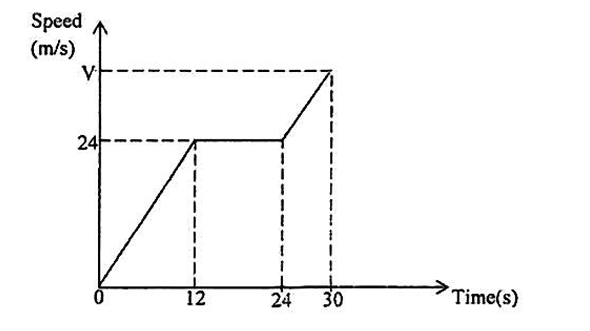
The diagram below is a speed-time graph of a particle which accelerates uniformly from rest for 12 seconds until it reaches a speed of 24 m/s. It moves at a constant speed for a further 12 seconds before it accelerates uniformly for another 6 seconds to a speed of V m/s.
(a) Calculate its acceleration for the first 12 seconds.
- A12m/s2
- B2m/s2
- C24m/s2
- D1m/s2
43.
The diagram below is a speed-time graph of a particle which accelerates uniformly from rest for 12 seconds until it reaches a speed of 24 m/s. It moves at a constant speed for a further 12 seconds before it accelerates uniformly for another 6 seconds to a speed of V m/s.
(b) Find the distance which the particle covered in the first 24 seconds.
- A432m
- B144m
- C576m
- D288m
44.
The diagram below is a speed-time graph of a particle which accelerates uniformly from rest for 12 seconds until it reaches a speed of 24 m/s. It moves at a constant speed for a further 12 seconds before it accelerates uniformly for another 6 seconds to a speed of V m/s.
(c) Given that the total distance covered was 600 m, calculate the value of V.
- A24m/s
- B40m/s
- C32m/s
- D28m/s