
Save as PDF or print — the answers and worked solutions live online, where your work gets marked free.
Examinations Council of Zambia — past paper
ECZ 2019 GCE Paper 1 — Mathematics
44 questions · downloaded from g12titan.com, where this paper is marked free online

1.
The Venn diagram below shows three sets A,B and C . Use set notation to describe the shaded region.
- A(A∪B)∩C
- B(A∪B)′∩C
- C(A∪B)′∪C
- DA∩B∩C
2.
Given that E={0,1,2,3,4,5,6,7,8,9},A={2,3,6,8} and B={3,6,7,9}, list (A∩B)'.
- A{3,6}
- B{2,3,6,7,8,9}
- C{2,7,8,9}
- D{0,1,2,4,5,7,8,9}
3.
Simplify 4 − 2(b − a) − 1.
- A2a − 2b + 3
- B2a + 2b + 3
- C−2a − 2b + 3
- D2a − 2b − 5
4.
Evaluate (⁴√81)3.
- A12
- B27
- C9
- D81
5.
Factorise completely 32x2 − 50.
- A2(16x2 − 25)
- B(8x − 10)(4x + 5)
- C2(4x − 5)2
- D2(4x − 5)(4x + 5)
6.
Find the gradient of a line which passes through (−5, 3) and (−4, 1).
- A2
- B−½
- C−2
- D½
7.
The vector PQ = -32. Given that the point P is (1, 4), find the coordinates of the point Q.
- A(4, 2)
- B(−2, 6)
- C(2, −6)
- D(−4, −2)
8.
Given that S = 10-4-211, find ST.
- A[1 −2; 0 1; −4 1]
- B[−4 0 1; 1 1 −2]
- C[1 0 −4; −2 1 1]
- D[−2 1 1; 1 0 −4]
9.
Given that R = 2-113 and S = 10-4-211, find RS.
- A[2 0 4; −2 3 3]
- B[4 1 −9; −5 3 −1]
- C[0 −1 −9; 7 3 −1]
- D[4 −1 −9; −5 3 −1]
10.
For the sequence −10, −7, −4, −1, …, find the 17th term.
- A41
- B−58
- C38
- D44
11.
For the sequence −10, −7, −4, −1, …, find the sum of the first 20 terms.
- A370
- B740
- C570
- D185
12.
There are 4 blue and 5 white marbles in a bag. What is the probability of randomly picking a white marble?
- A49
- B15
- C59
- D45
13.
Solve the equation 2x2 + 5x − 3 = 0.
- Ax = 2 or x = −3
- Bx = −½ or x = 3
- Cx = 1 or x = −32
- Dx = ½ or x = −3
14.
The diagram shows a prism with a base that is a regular hexagon. How many planes of symmetry does it have?
- A6
- B12
- C8
- D7
15.
The diagram below shows point A(60°N, 30°W), B(30°S, 30°W) and C(30°S, 75°E) on the surface of the Earth. If the local time at B is 15 00, what is the local time at C?
- A08 00
- B22 00
- C18 30
- D12 00
16.
The points A(60°N, 30°W) and B(30°S, 30°W) lie on the same meridian. It takes a plane 6 hours to fly from A to B. What is its speed in knots?
- A540 knots
- B900 knots
- C150 knots
- D5 400 knots
17.
Evaluate 30 × 33 + 31.
- A27
- B12
- C84
- D30
18.
The diagram shows a sector of a circle with centre O and radius 4.2 cm. Angle AOB = θ. Given that the area of the sector AOB is 9.24 cm2, find the value of θ. [π = 227]
- A30°
- B120°
- C60°
- D45°
19.
The mass, m, of a block of wood is 876.4 g, correct to 1 decimal place. Complete the statement: … ≤ m ≤ …
- A876.35 ≤ m ≤ 876.45
- B876.3 ≤ m ≤ 876.5
- C875.9 ≤ m ≤ 876.9
- D876.0 ≤ m ≤ 876.8
20.
The length of a piece of wire is 15.2 cm, correct to 1 decimal place. What is the relative error of the length of the piece of wire?
- A1152
- B11520
- C1304
- D176
21.
The diagram below shows Mr Moenda's trip. He travels on a bearing of 141° from A to B. He then decides to continue with his trip from B on a bearing of 255° to C. The angle BCA = 35°.
Find the bearing of A from B.
- A141°
- B321°
- C219°
- D039°
22.
The diagram below shows Mr Moenda's trip. He travels on a bearing of 141° from A to B. He then decides to continue with his trip from B on a bearing of 255° to C. The angle BCA = 35°.
Find the bearing of A from C.
- A010°
- B075°
- C110°
- D040°
23.
The functions f and g are defined as f(x) = 2x + 1 and g(x) = 3x − 52. Find f-1(x).
- Ax + 12
- B2x − 1
- Cx − 12
- D12x + 1
24.
The functions f and g are defined as f(x) = 2x + 1 and g(x) = 3x − 52. Find fg(x).
- A3x − 4
- B6x − 52
- C3x − 5
- D3x − 32
25.
The functions f and g are defined as f(x) = 2x + 1 and g(x) = 3x − 52. Find fg(4).
- A12
- B7
- C16
- D8
26.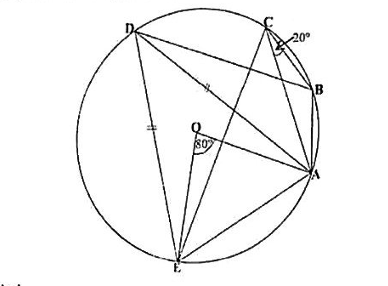
In the diagram below, A, B, C, D and E are points on the circumference of the circle with centre O. DE = AD, AĈB = 20° and AÔE = 80°. Find AD̂E.
- A80°
- B40°
- C20°
- D60°
27.
In the diagram below, A, B, C, D and E are points on the circumference of the circle with centre O. DE = AD, AĈB = 20° and AÔE = 80°. Find DÂE.
- A40°
- B55°
- C70°
- D35°
28.
In the diagram below, A, B, C, D and E are points on the circumference of the circle with centre O. DE = AD, AĈB = 20° and AÔE = 80°. Find BÂD.
- A50°
- B70°
- C90°
- D30°
29.
A point R(−3, 1) is mapped onto a point S(2, −1) by a translation T. Express T as a column vector.
- A[−5; 2]
- B[5; −2]
- C[−1; 0]
- D[2; −1]
30.
An incomplete program in pseudocode reads: Start; Enter ……; m = ……; Output m; Stop. The program calculates the mean (m) of 10 numbers whose sum is S. Which statements correctly fill the two blanks?
- AEnter m; m = S × 10
- BEnter S; m = 10S
- CEnter S; m = S10
- DEnter 10; m = S + 10
31.
Given that y varies directly as x and inversely as the square of z, and that y = 10 when x = 32 and z = 4, find the value of k, the constant of variation.
- A5
- B10
- C2
- D8
32.
y varies directly as x and inversely as the square of z, with constant k = 5 (so y = 5xz2). Find y when x = 20 and z = 5.
- A20
- B4
- C100
- D2
33.
y varies directly as x and inversely as the square of z, with constant k = 5 (so y = 5xz2). Find z when x = 9 and y = 5.
- Az = 3 only
- Bz = 9 or −9
- Cz = 3 or −3
- Dz = ±√5
34.
A company's working capital consists of 450 10% preference shares of K50.00 each and 700 ordinary shares of K10.00 each. After 6 months, the company declared a dividend of K5 750.00. How much dividend will be paid to each ordinary shareholder?
- AK8.20
- BK2 250.00
- CK5.00
- DK3.50
35.
The ratio of the volumes of two similar solids is 64 : 27. The surface area of the smaller solid is 180 cm2. What is the surface area of the bigger solid?
- A405 cm2
- B240 cm2
- C426⅔ cm2
- D320 cm2
36.
The diagram shows triangle KLM in which KL = 16 cm, angle KLM = 150° and its area is 32 cm2. Calculate the length of LM.
- A4 cm
- B8 cm
- C16 cm
- D2 cm
37.
The equation of line A is 3x + 2y = 10. Line B is parallel to line A and passes through the point (4, 6). Find the equation of the line B.
- Ay = −³⁄₂x + 12
- By = ³⁄₂x + 12
- Cy = −³⁄₂x + 5
- Dy = −²⁄₃x + 12
38.
The diagram shows an unshaded region R bounded by four lines: the dashed horizontal line y = 6; the vertical line x = 2; the line through (0, 0) and (−2, 2); and the line through (−2, 0) and (0, 4). Write four inequalities that define R.
- Ay < 6, x ≤ 2, y > −x, y ≤ 2x + 4
- By < 6, x ≤ 2, y > −x, y ≥ 2x + 4
- Cy ≤ 6, x < 2, y ≥ −x, y ≤ 2x + 4
- Dy > 6, x ≥ 2, y < −x, y ≥ 2x + 4
39.
Find the integral of 3x32 − 5x + 1x2 with respect to x.
- A⅜x4 − 5x2 − 1x + c
- B⅜x⁴ − ⁵⁄₂x² + 1x + c
- C9x22 − 5 − 2x3 + c
- D⅜x⁴ − ⁵⁄₂x² − 1x + c
40.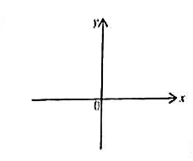
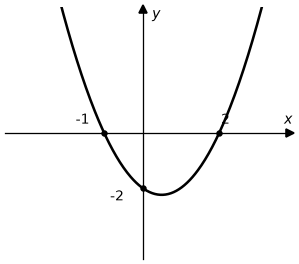
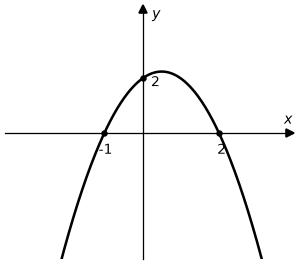
A function y = (1 + x)(x − 2). Which description matches the sketch of its graph?
- A
- B
- C
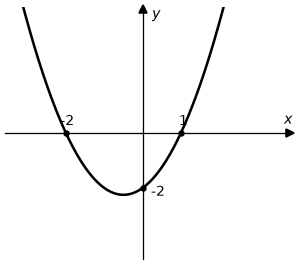
- D

41.
A function y = (1 + x)(x − 2). Find the minimum value of y.
- A−2
- B−94
- C−12
- D−3
42.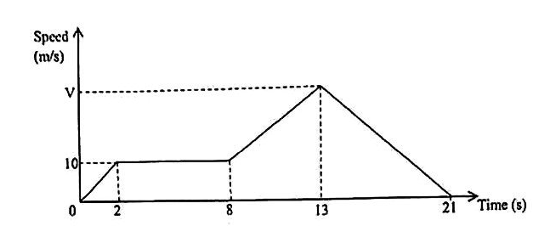
The diagram below shows a speed time graph of an object. It starts from rest and accelerates uniformly for 2 seconds until it reaches a speed of 10 m/s. It moves at this constant speed for 6 seconds then accelerates until it reaches a speed of V m/s after 5 seconds. Finally, it retards for the next 8 seconds until it comes to a halt.
Calculate the acceleration during the first 2 seconds.
- A10 m/s2
- B2 m/s2
- C5 m/s2
- D20 m/s2
43.
In the same journey (rest → 10 m/s in 2 s; constant for 6 s; accelerating from 8 s to 13 s up to V m/s; then retarding to rest over the last 8 seconds), find the value of V if the retardation in the last 8 seconds is 3 m/s2.
- A30 m/s
- B18 m/s
- C11 m/s
- D24 m/s
44.
In the same journey (rest → 10 m/s in 2 s; constant 10 m/s for 6 s; speeding up to 24 m/s between 8 s and 13 s; then retarding to rest at 21 s), calculate the average speed for the whole journey.
- A14.5 m/s
- B≈ 12 m/s
- C24 m/s
- D10 m/s