
Save as PDF or print — the answers and worked solutions live online, where your work gets marked free.
Examinations Council of Zambia — past paper
ECZ 2019 O-Level Paper 2 — Mathematics
12 questions · downloaded from g12titan.com, where this paper is marked free online

1.
(a)
Given that matrix A = 6x23,
(a(i))
find the value of x for which the determinant of A is 36, [2]
(a(ii))
hence, find the inverse of A. [2]
(b)
A box contains 4 red pens and 5 green pens. A pen is picked at random from the box without replacement and a second pen is then picked.
(b(i))
Draw a tree diagram to illustrate the outcomes. [3]
(b(ii))
What is the probability of picking one red pen and one green pen? [2]
2.
(a)
Simplify 6x2 - 24x - 2. [2]
(b)
Given the geometric progression 4, 8, 16, ..., find
(b(i))
the geometric mean of 256 and 1 024, [2]
(b(ii))
the 11th term, [2]
(b(iii))
the sum of the first 11 terms. [3]
3.
(a)
Solve the equation p2 - p = 4, giving your answers correct to 2 decimal places. [5]
(b)
The Venn diagram below shows the number of elements in sets A, B and C.
Find
(b(i))
x, such that n(B) = n(B union C)', [2]
(b(ii))
y, such that n(C) = n(A), [1]
(b(iii))
n(E), [1]
(b(iv))
n(B'). [1]
4.
(a)
Express 52x - 4 - 43x + 5 as a single fraction in its simplest form. [3]
(b)
The program below is given in the form of a pseudocode.
Begin
Enter length
If length < 0
Then display "error message" and re-enter positive length
Else enter height
If height < 0
Then display "error message" and re-enter positive height
Else volume = 13 * l * l * h
End if
Display volume
End
Draw the corresponding flowchart for the information given above. [5]
5.
(a(i))
Construct triangle ABC in which AB = 8 cm, angle BAC = 110° and angle ABC = 35°. [1]
(a(ii))
Measure and write the length of BC. [1]
(b)
Within the triangle ABC, construct the locus of points which are
(b(i))
3 cm from AB, [1]
(b(ii))
equidistant from AC and BC, [2]
(b(iii))
4 cm from A. [1]
(c)
A point Q inside triangle ABC is greater than or equal to 3 cm from AB, less than or equal to 4 cm from A and nearer to AC than BC. Indicate clearly, by shading, the region in which Q must lie. [2]
6.
(a)
In the diagram below, OB = 4OA and AC = 5AX. M is the midpoint of BC, OA = a and BM = b.
(a(i))
Express in terms of a and/or b.
(a(i)(a))
AB, [1]
(a(i)(b))
AC, [1]
(a(i)(c))
OM. [1]
(a(ii))
Show that OX = (25)(4a + b). [2]
(b)
Find the equation of the normal to the curve y = 5x3 - 6x2 + 2x + 5 at the point (1, 2). [3]
7.
The vertices of triangle ABC are A(1, 1), B(1, 3) and C(3, 3). The vertices of triangle A1B1C1 are A1(-1, 1), B1(-3, 1) and C1(-3, 3).
(a)
Using a scale of 1 cm to represent 1 unit on each axis, draw the x and y axes for -6 ≤ x ≤ 6 and -6 ≤ y ≤ 6. Draw and label triangles ABC and A1B1C1. [2]
(b)
Describe fully a single transformation that maps triangle ABC onto triangle A1B1C1. [2]
(c)
An enlargement maps triangle ABC onto triangle A2B2C2 with vertices A2(-2, -2), B2(-2, -6) and C2(-6, -6).
(c(i))
Draw and label triangle A2B2C2. [1]
(c(ii))
Find the scale factor. [1]
(d)
The transformation represented by the matrix 2001 maps triangle ABC onto triangle A3B3C3.
(d(i))
Find the coordinates of the vertices A3, B3 and C3. [2]
(d(ii))
Draw and label triangle A3B3C3. [1]
(e)
Triangle ABC is mapped onto triangle A4B4C4 with vertices A4(1, -2), B4(1, 0) and C4(3, -6).
(e(i))
Draw and label triangle A4B4C4. [1]
(e(ii))
Find the matrix representing this transformation. [2]
8.
The table below shows the expenditure of 90 farmers in a particular farming season. Amount in K0<x≤100100<x≤200200<x≤300300<x≤400400<x≤500500<x≤600600<x≤700700<x≤800Number of farmers5161717141272
(a)
Calculate the standard deviation. [6]
(b(i))
Using the table above, copy and complete the cumulative frequency table below. Amount in K≤0≤100≤200≤300≤400≤500≤600≤700≤800Frequency0521385569 [1]
(b(ii))
Using a scale of 2 cm to represent 100 units on the horizontal axis and 2 cm to represent 10 units on the vertical axis, draw a smooth cumulative frequency curve. [3]
(b(iii))
Showing your method clearly, use your graph to estimate the interquartile range. [2]
9.
Kuunika wishes to build a lodge with single and double rooms. He needs to decide the number of each room type he should build to maximize profit. Let x represent the number of single rooms and y the number of double rooms.
(a)
Write the inequalities which represent each of the following conditions:
(a(i))
There must be at least one single room. [1]
(a(ii))
There must be at least 10 rooms altogether. [1]
(a(iii))
The total number of rooms should not exceed 15. [1]
(a(iv))
The number of double rooms must be at least twice the number of single rooms. [1]
(a(v))
The number of double rooms should not be more than 12. [1]
(b)
Using a scale of 2 cm to 5 units on both axes, draw x and y axes for 0 ≤ x ≤ 16 and 0 ≤ y ≤ 16 respectively and shade the unwanted region to indicate clearly the region where the solution of the inequalities lie. [5]
(c)
The rate for a single room is K600.00 and K900.00 for a double room. How many rooms of each type should Kuunika build to maximize the income? [2]
10.
(a)
The diagram below shows part of the graphs of y = x3 + 2x - 1 and y = 10x.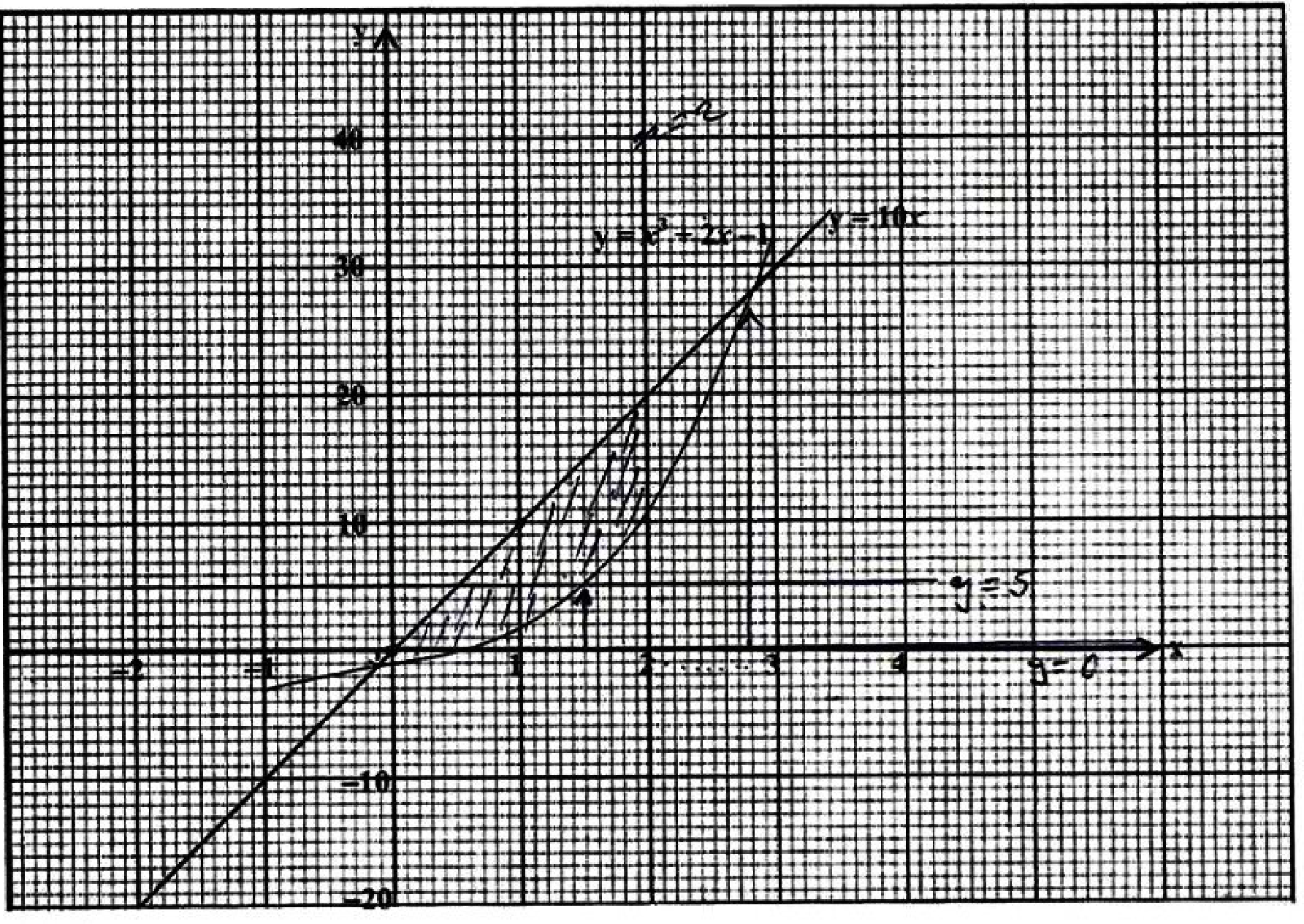
(a(i))
Use the graphs to solve the equations
(a(i)(a))
x3 + 2x = 6, [2]
(a(i)(b))
x3 + 2x - 1 = 10x. [2]
(a(ii))
Calculate an estimate of
(a(ii)(a))
the gradient of the curve at the point (2, 11), [2]
(a(ii)(b))
the area bounded by the curve, y = 10x, y = 0 and x = 2. [3]
(b)
Evaluate ∫31 (3x2 + 4x) dx. [3]
11.
(a)
The points P, Q, R and T are on the surface of the earth as shown in the diagram below. [Take π as 3.142 and R = 3437 nm]
(a(i))
Find the difference in longitude between the points T and R. [2]
(a(ii))
Find, in nautical miles, the distance between
(a(ii)(a))
P and Q along the latitude 65° N, [2]
(a(ii)(b))
P and T along the longitude 90° W. [2]
(b)
The figure below shows a right pyramid with a vertex O and a square base ABCD of side 8 cm. Angle CPD = angle OPC = 90°.
Given that OA = OB = OC = OD = 10 cm, calculate
(b(i))
the height OP, [4]
(b(ii))
the angle between the edge OC and the base PC. [2]
12.
(a)
The diagram below shows a triangle KMN in which KM = 8 km, MN = 10 km and angle KMN = 92°.
Calculate
(a(i))
KN, [5]
(a(ii))
the area of triangle KMN, [2]
(a(iii))
the shortest distance from M to KN. [2]
(b)
Solve the equation 2 tan θ = -3 for 0° ≤ θ ≤ 180°. [1]
(c)
Simplify 25p47q2 ÷ 5p621q4 × p15q. [2]