
Save as PDF or print — the answers and worked solutions live online, where your work gets marked free.
Examinations Council of Zambia — past paper
ECZ 2020 O-Level Paper 1 — Mathematics
44 questions · downloaded from g12titan.com, where this paper is marked free online

1.
Simplify 2(x + 3) - 3x(x - 2).
- A-3x2 + 8x + 6
- B-3x2 - 4x + 6
- C3x2 + 8x + 6
- D-3x2 + 2x + 6
2.
Evaluate (∛27)2.
- A6
- B9
- C27
- D729
3.
Factorise completely 16x2 - 100.
- A4(x - 5)(x + 5)
- B(4x - 10)(4x + 10)
- C4(2x - 5)(2x + 5)
- D(2x - 5)(2x + 5)
4.
The points A and B are (-5, 15) and (3w, w) respectively. Given that the midpoint of the straight line joining A and B is (5, 10), find the value of w.
- A103
- B-5
- C253
- D5
5.
The vector RS = -43. Given that R is a point (-2, 1), find the coordinates of point S.
- A(-6, 4)
- B(2, -2)
- C(-6, -2)
- D(6, 4)
6.
On the Venn diagram in the answer space below, shade the set A' ∩ (B ∪ C).
- A

- B

- C

- D

7.
Given that M = -3-1420-2 and N = -21, find
(a) MT.
- A-3-1420-2
- B-340-12-2
- C-340-122
- D04-3-22-1
8.
Given that M = -3-1420-2 and N = -21, find
(b) MN as a single matrix.
- A7-10-2
- B5-62
- C5-6-2
- DMN is not possible
9.
For the sequence 7, 11, 15, 19, ..., find the 9th term.
- A43
- B35
- C47
- D39
10.
For the sequence 7, 11, 15, 19, ..., find the sum of the first 16 terms.
- A592
- B616
- C1184
- D296
11.
The probability of Masamushi failing an examination is 310. What is the probability that she will pass that particular examination?
- A310
- B710
- C1310
- D1
12.
A plan of a play boat is drawn to a scale of 1 : 20. If the actual area of the base of the boat is 0.64 m2, calculate its area on the map in square centimetres.
- A12.8 cm2
- B6.4 cm2
- C16 cm2
- D32 cm2
13.
Given that E = {3, 6, 9, 12, 15, 18}, A = {6, 9, 12} and B = {3, 6, 18}, list A ∩ B'.
- A{6}
- B{9, 12, 15}
- C{3, 18}
- D{9, 12}
14.
Solve the equation 3x + 3 = 275.
- A12
- B2
- C18
- D5
15.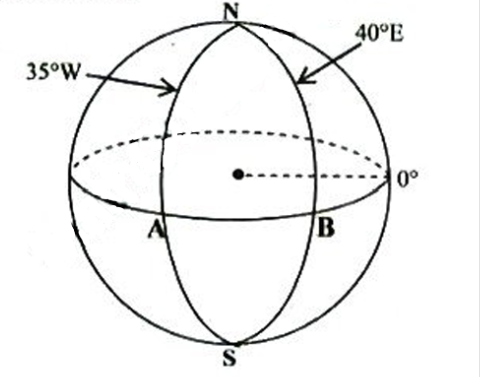
The diagram below shows two towns A and B on the equator. A is on longitude 35°W and B is on longitude 40°E. Find the time at A when it is 18 00 hours at B.
- A23 00 hours
- B13 00 hours
- C11 00 hours
- D13 20 hours
16.
The diagram below shows two towns A and B on the equator. A is on longitude 35°W and B is on longitude 40°E. A plane flying from A to B takes 5 hours. Find its speed.
- A750 knots
- B4500 knots
- C900 knots
- D180 knots
17.
The functions f and g are defined by f(x) = 3x - 2 and g(x) = 4x + 1. Find f-1(x).
- Ax - 23
- B13x - 2
- C3x + 2
- Dx + 23
18.
The functions f and g are defined by f(x) = 3x - 2 and g(x) = 4x + 1. Find gf(x).
- A12x - 7
- B12x + 1
- C12x - 8
- D7x - 1
19.
The functions f and g are defined by f(x) = 3x - 2 and g(x) = 4x + 1. Find gf(-2).
- A31
- B-31
- C-17
- D17
20.
Chiyalwa estimated the length of a string as 15 cm. The true length of the string was 14.6 cm. Find the absolute error in Chiyalwa's estimate.
- A0.6 cm
- B29.6 cm
- C0.4 cm
- D0.04 cm
21.
Chiyalwa estimated the length of a string as 15 cm. The true length of the string was 14.6 cm. Find the relative error in Chiyalwa's estimate.
- A275
- B0.4
- C173
- D273
22.
A point A(2, 4) is mapped onto A'(-3, 5) by a translation T. Find the translation T.
- A-51
- B5-1
- C-19
- D-59
23.
Integrate y = x-3 - 3x4 + 5.
- A-3x-4 - 12x3
- B-12x2 - 3x55 + 5x + c
- C12x2 - 3x55 + 5x + c
- D-12x2 - 3x5 + 5x + c
24.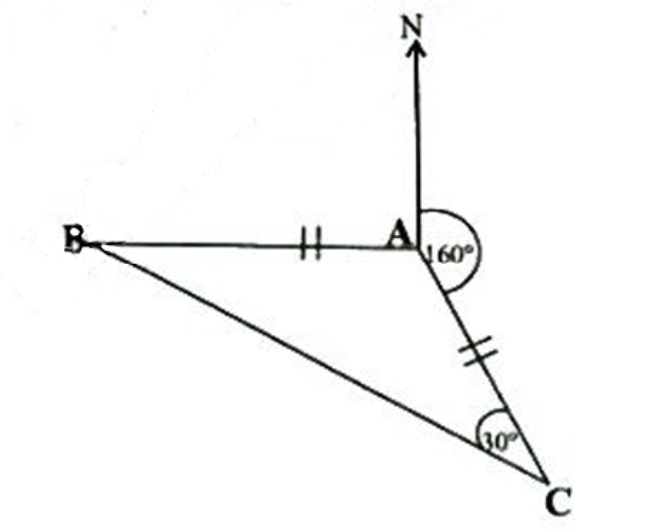
In the diagram below, the bearing of C from A is 160°. Angle ACB is 30° and AB = AC. Find
(a) angle BAC.
- A60°
- B30°
- C120°
- D150°
25.
In the diagram below, the bearing of C from A is 160°. Angle ACB is 30° and AB = AC. Find
(b) the bearing of A from C.
- A210°
- B020°
- C160°
- D340°
26.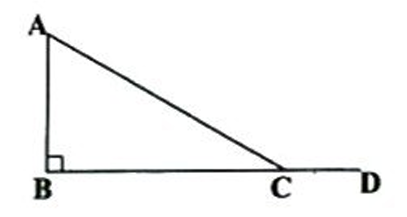
The diagram below shows triangle ABC in which angle ABC = 90°. BC is produced to D. Given that tan(angle BAC) = 43, find the value of cos(angle ACD).
- A-45
- B45
- C-35
- D35
27.
Calculate the radius of a semicircle whose area is 77 cm2. [Take π to be 227.]
- A3.5 cm
- B7 cm
- C14 cm
- D49 cm
28.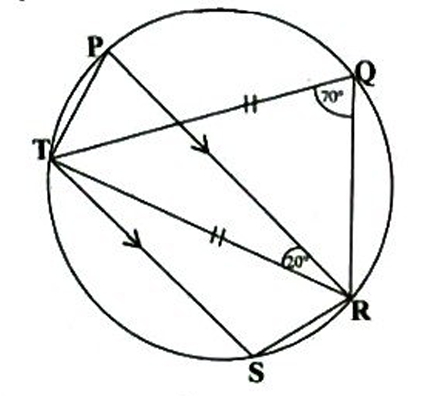
In the diagram below, P, Q, R, S and T lie on a circle and TQ = TR. PR and TS are parallel. Angle TQR = 70° and angle TRP = 20°. Find
(a) angle RTQ.
- A70°
- B55°
- C40°
- D20°
29.
In the diagram below, P, Q, R, S and T lie on a circle and TQ = TR. PR and TS are parallel. Angle TQR = 70° and angle TRP = 20°. Find
(b) angle RST.
- A70°
- B40°
- C90°
- D110°
30.
In the diagram below, P, Q, R, S and T lie on a circle and TQ = TR. PR and TS are parallel. Angle TQR = 70° and angle TRP = 20°. Find
(c) angle TRS.
- A50°
- B20°
- C70°
- D40°
31.
A woman has 500 company shares with a nominal value of K70.00 each, which she bought at K30.00 each. How much did she pay for the shares?
- AK35 000.00
- BK15 000.00
- CK20 000.00
- DK150.00
32.
P is the point (3, 1) and Q is another point such that the gradient of the line PQ is -12. Write down the equation of PQ.
- A2y = x + 5
- By = -2x + 5
- C2y = -x + 5
- D2y = -x - 5
33.
An incomplete pseudocode for a program that calculates the curved surface area S of a cone with radius r and slant height l is: StartEnter ...... / S = ...... / Output SStop. Which correctly completes the two blanks?
- AEnter r, h ; S = π*r2*h
- BEnter r, l ; S = 2*π*r*l
- CEnter S ; r = Sπ*l
- DEnter r, l ; S = π*r*l
34.
The diagram below is a right triangular pyramid ABCD with AB = BC = CA. What is the order of rotational symmetry of the pyramid about OD?
- A3
- B1
- C2
- D6
35.
It is given that y varies directly as the cube root of x and inversely as the square of z, and y = 2 when x = 8 and z = 4. Find k, the constant of variation.
- A2
- B16
- C8
- D116
36.
It is given that y varies directly as the cube root of x and inversely as the square of z, and y = 2 when x = 8 and z = 4. Find the equation connecting x, y and z.
- Ay = ∛x16z2
- By = (16z2) / ∛x
- Cy = 16∛xz2
- Dy = 16x3z2
37.
It is given that y varies directly as the cube root of x and inversely as the square of z, and y = 2 when x = 8 and z = 4. Find the values of z when y = 12 and x = 27.
- Az = 2 only
- Bz = ±4
- Cz = ±16
- Dz = ±2
38.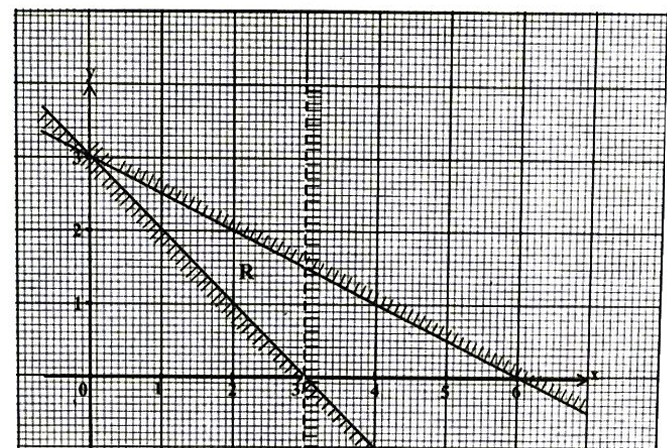
Write three inequalities that define the unshaded region R.
- Ax < 3, x + y ≥ 3, x + 2y ≤ 6
- Bx > 3, x + y ≥ 3, x + 2y ≤ 6
- Cx < 3, x + y ≤ 3, x + 2y ≥ 6
- Dx < 3, x + y ≥ 3, x + 2y ≥ 6
39.
Solve the equation 5x2 = x.
- Ax = 15 only
- Bx = 0 or x = 15
- Cx = 0 or x = 5
- Dx = ±15
40.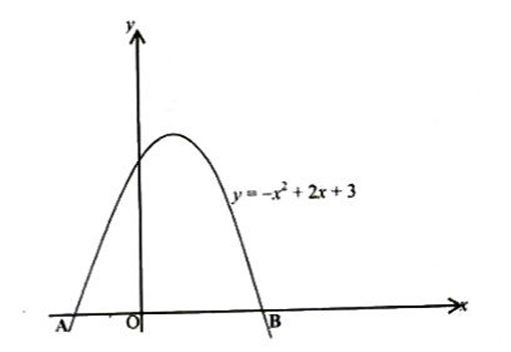
The diagram below shows the sketch of the graph of y = -x2 + 2x + 3 cutting the x-axis at A and B. Find the
(i) coordinates of A.
- A(3, 0)
- B(0, 3)
- C(-1, 0)
- D(1, 0)
41.
The diagram below shows the sketch of the graph of y = -x2 + 2x + 3 cutting the x-axis at A and B. Find the
(ii) maximum value of the graph.
- A1
- B3
- C-1
- D4
42.
The diagram below is a graph of a moving object which decelerates uniformly at 8 m/s2 from a speed of 52 m/s to v m/s in 6 seconds. It then moves at a constant speed for 10 seconds and finally decelerates uniformly to come to rest in 4 seconds. Calculate the
(a) speed v.
- A4 m/s
- B48 m/s
- C44 m/s
- D8 m/s
43.
The diagram below is a graph of a moving object which decelerates uniformly at 8 m/s2 from a speed of 52 m/s to v m/s in 6 seconds. It then moves at a constant speed for 10 seconds and finally decelerates uniformly to come to rest in 4 seconds. Calculate the
(b) total distance travelled for the whole journey.
- A876 m
- B216 m
- C200 m
- D312 m
44.
The diagram below is a graph of a moving object which decelerates uniformly at 8 m/s2 from a speed of 52 m/s to v m/s in 6 seconds. It then moves at a constant speed for 10 seconds and finally decelerates uniformly to come to rest in 4 seconds. Calculate the
(c) average speed for the whole journey.
- A43.8 m/s
- B18 m/s
- C10.8 m/s
- D12 m/s