
Save as PDF or print — the answers and worked solutions live online, where your work gets marked free.
Examinations Council of Zambia — past paper
ECZ 2021 GCE Paper 2 — Mathematics
12 questions · downloaded from g12titan.com, where this paper is marked free online

1.
(a)
Simplify a2 x2 - b2 y2ax + by. [2]
(b)
Given the geometric progression 4, 2, 1, ..., find
(b(i))
the 7th term, [2]
(b(ii))
the sum of the first 9 terms. [3]
(c)
Find the geometric mean of 196 and 15 625. [2]
2.
(a)
Solve the equation 3x + 5x = 12, giving your answers correct to 2 decimal places. [5]
(b)
A boy has a bag containing 5 green balls, 1 red ball and 4 blue balls. A ball is selected at random from the bag and not replaced. A second ball is then selected.
(b(i))
Draw a tree diagram to show all the possible outcomes. [2]
(b(ii))
Find the probability that the two balls are of the same colour. [3]
3.
Answer the whole of this question on a sheet of plain paper.
(a)
Construct triangle EFG in which EF = 11 cm, EG = 6.5 cm and GF = 10 cm. [1]
(b)
Measure and write the size of angle EGF. [1]
(c)
Within triangle EFG, construct the locus of points which are
(c(i))
equidistant from EG and EF, [2]
(c(ii))
2.5 cm from EF, [1]
(c(iii))
equidistant from E and F. [1]
(d)
A point P, within triangle EFG is such that it is nearer to EF than to EG, nearer to E than to F and is greater than or equal to 2.5 cm away from EF. Indicate clearly by shading, the region in which P must lie. [2]
4.
(a)
In a group of 60 football fans, 37 support Team A, 28 support Team B and 29 support Team C.
2 support Team A and Team C only,
5 support Team B and Team C only,
7 support Team A and Team B only,
18 support Team A only and
10 support all the three teams.
(a(i))
Illustrate this information in a Venn diagram. [2]
(a(ii))
Find
(a(ii)(a))
n(B)', [1]
(a(ii)(b))
n(A ∩ B)', [1]
(a(ii)(c))
n(A ∪ B)'. [1]
(b)
Given that the determinant of the matrix A = 2x - 114-2 is -10, find
(b(i))
the value of x, [2]
(b(ii))
the inverse of matrix A. [2]
5.
(a)
Find the equation of a tangent to the curve y = 5x3 - 7x2 + 3x + 2 at the point (1, 3). [3]
(b)
In the diagram below OA = a, OB = b and X is the midpoint of AB.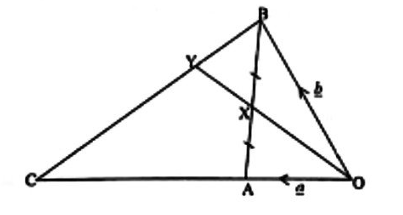
(b(i))
Express in terms of a and/or b
(b(i)(a))
BA, [1]
(b(i)(b))
AX, [1]
(b(i)(c))
OX. [2]
(b(ii))
Given that OC = 3a, express BC in terms of a and b. [1]
6.
(a)
Express 22x - 1 - 33x - 1 as a single fraction in its simplest form. [3]
(b)
The programme below is given in form of a pseudocode.
Start
Enter length
If length < 0 THEN
Display error message "length must be positive"
Else enter height
If height < 0 THEN
Display error message "height must be positive"
Else volume = 13 * length ∧ 3 * height
End if
Display volume
Stop
Draw a corresponding flowchart for this pseudocode. [5]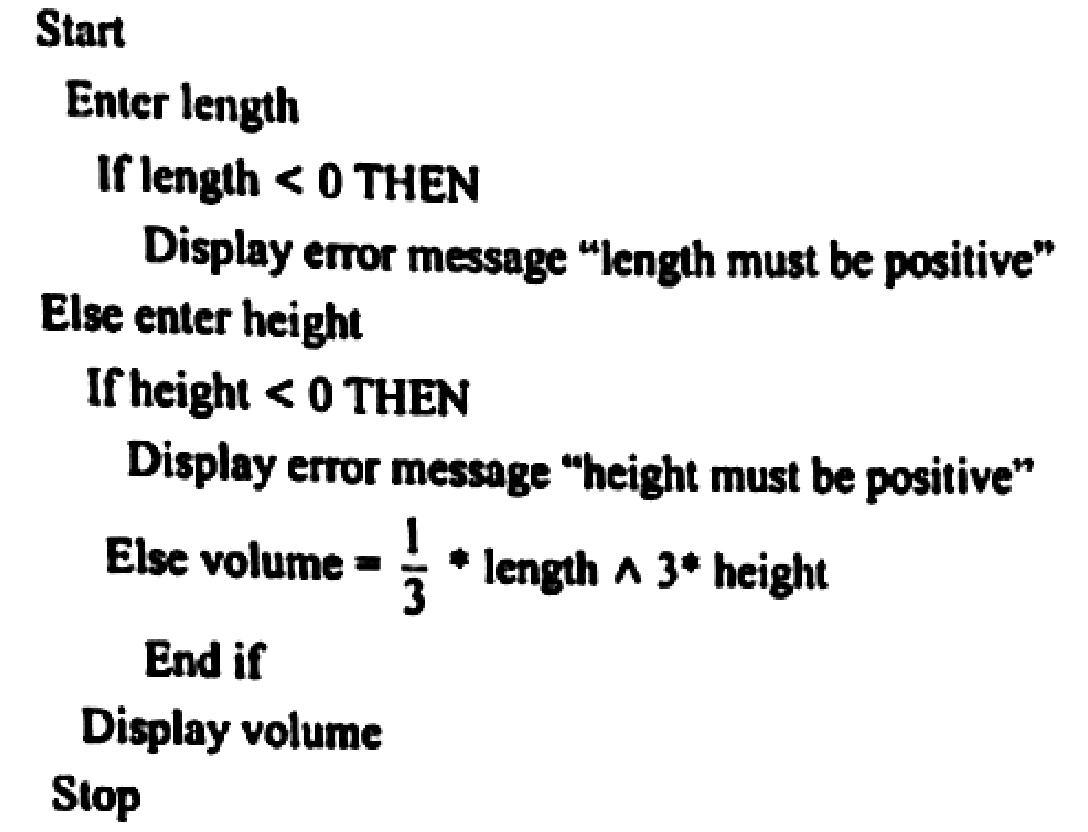
7.
(a)
In triangle ABC below, AB = 275 m, AC = 45 m and BC = 300 m.
Calculate
(a(i))
angle BAC, [5]
(a(ii))
the area of triangle ABC, [2]
(a(iii))
the shortest distance from A to BC. [2]
(b)
Solve the equation cos θ = -0.5 for which 180° ≤ θ ≤ 360°. [1]
(c)
Simplify 18a2 b16c3 d2 ÷ 24a15cb3 × 8c2 d330a3 b. [2]
8.
(a)
The following diagram shows the graph of y = -(15)x(12 - x2).
(a(i))
Use the graph to solve the equations
(a(i)(a))
-(15)x(12 - x2) = 1, [2]
(a(i)(b))
-(15)x(12 - x2) = -2. [2]
(a(ii))
Calculate an estimate of the
(a(ii)(a))
area bounded by the curve and the lines y = 0, x = -3 and x = -1, [3]
(a(ii)(b))
gradient of the curve at the point (3, -1.8). [2]
(b)
Find the equation of the curve for which dydx = 2x - 3 where x = y = 3. [3]
9.
The following table shows the results obtained by 60 learners in a mathematics test.
Marks scored0 < x ≤ 1010 < x ≤ 2020 < x ≤ 3030 < x ≤ 4040 < x ≤ 5050 < x ≤ 6060 < x ≤ 7070 < x ≤ 80Number of learners26101512843
(a)
Calculate the standard deviation. [6]
(b)
Answer this part of the question on a sheet of graph paper.
(b(i))
Using the table above, copy and complete the cumulative frequency table below.
Marks scored≤ 0≤ 10≤ 20≤ 30≤ 40≤ 50≤ 60≤ 70≤ 80Number of learners028183345 [1]
(b(ii))
Using a scale of 2 cm to represent 10 units on both axes for 0 ≤ x ≤ 80 and 0 ≤ y ≤ 60, draw a smooth cumulative frequency curve. [3]
(b(iii))
Showing your method clearly, use your graph to estimate the interquartile range. [2]
10.
Answer the whole of this question on a sheet of graph paper.
A businessman orders two types of vehicles namely; sedans and vans for sale. He orders at least 60 sedans and at least 20 vans. He orders not more than 180 vehicles altogether. He makes sure that the number of vans ordered are not more than the number of sedans ordered.
(a)
Given that x represents the number of sedans and y represents the number of vans, write four inequalities which satisfy the above conditions. [4]
(b)
Using a scale of 2 cm to represent 20 vehicles on each axis, draw x and y axes from 0 to 180 and shade the unwanted region to show clearly the region where the solution of the inequalities lie. [4]
(c)
If the profit on the sale of a sedan is K10 000.00 and that on each van is K12 000.00, how many of each type should he order to make maximum profit? [2]
(d)
Find this maximum profit. [2]
11.
Answer the whole of this question on a sheet of graph paper.
The vertices of triangle ABC are A(40, 30), B(40, 70) and C(70, 70) while that of triangle A1B1C1 are A1(20, 15), B1(20, 35) and C1(35, 35).
(a)
Using a scale of 2 cm to represent 10 units on each axis for values of x and y from 0 to 70, draw and label triangles ABC and A1B1C1. [2]
(b)
Describe fully a single transformation that maps triangle ABC onto triangle A1B1C1. [3]
(c)
A rotation of 180° about (20, 40) maps triangle A1B1C1 onto triangle A2B2C2. Determine the coordinates of A2, B2 and C2. [3]
(d)
Triangle A1B1C1 is mapped onto triangle A3B3C3 by a single transformation with vertices A3(40, 15), B3(40, 35) and C3(70, 35).
(d(i))
Draw and label triangle A3B3C3. [1]
(d(ii))
Describe fully this transformation. [3]
12.
(a)
The points A, B, C and D are on the surface of the earth as shown in the following diagram. (Take π as 3.142, R = 6 370 km or 3 437 nm)
(a(i))
Determine the difference in longitude between points A and B. [1]
(a(ii))
Calculate the distance between points
(a(ii)(a))
C and D along the equator in nautical miles, [2]
(a(ii)(b))
B and D along longitude NBDS in kilometres. [3]
(b)
The following diagram shows a frustum of a cone. The radii of the circles at the top and bottom are 1.5 cm and 5 cm respectively. Its height is 7 cm.
Calculate the volume of the frustum. (Take π as 3.142) [6]