
Save as PDF or print — the answers and worked solutions live online, where your work gets marked free.
Examinations Council of Zambia — past paper
ECZ 2021 O-Level Paper 1 — Mathematics
44 questions · downloaded from g12titan.com, where this paper is marked free online

1.
Use set notation to describe the shaded part in the Venn diagram below.
- AA∩(B∪C)
- BA∩(B∩C)
- CA∪B∪C
- DA∪(B∩C)
2.
It is given that the universal set E={ first 8 whole numbers } and A={ even numbers }. List set A.
- A{2,4,6,8}
- B{1,3,5,7}
- C{0,2,4,6}
- D{0,2,4,6,8}
3.
Simplify 2y - 3(x - 4) - y.
- A3y - 3x + 12
- By - 3x + 12
- Cy + 3x + 12
- Dy - 3x - 12
4.
Evaluate -32 + 32.
- A0
- B18
- C-18
- D9
5.
Solve the equation (2x - 5)(x + 3) = 0
- Ax = 5 or x = -3
- Bx = 52 or x = -3
- Cx = 52 or x = 3
- Dx = -52 or x = 3
6.
Find the equation of a straight line passing through the points (3, 4) and (7, 12).
- Ay = 2x + 2
- By = 4x - 8
- Cy = x + 1
- Dy = 2x - 2
7.
Factorise completely 3x3 - 12xy2.
- A3x(x - 2y)(x + 2y)
- B3(x - 2y)(x + 2y)
- Cx(3x - 12y2)
- D3x(x2 - 4y2)
8.
Matrix M = -234-2. Find the transpose of M.
- A4-2-23
- B-243-2
- C3-2-24
- D-234-2
9.
Matrix P = 2-103 and Q = -13. Find PQ.
- A-59
- B-2-309
- C13
- D5-9
10.
A certain company sells shares at K1.30 per share. A businesswoman had K9 100.00 to buy shares. How many shares did she get?
- A700 shares
- B11 830 shares
- C9 100 shares
- D7 000 shares
11.
The third and fourth terms of an Arithmetic progression are 6 and 3 respectively. Find the
(a) first term.
- A-3
- B9
- C12
- D15
12.
The third and fourth terms of an Arithmetic progression are 6 and 3 respectively. Find the
(b) formula for the nth term.
- A12 - 3n
- B15 - 3n
- C12 + 3n
- D15 + 3n
13.
The probability of getting a black button from a box is 29. Find the probability of getting a button which is not black.
- A119
- B79
- C29
- D19
14.
The diagram below shows a sector AOB with centre at O and radius 21cm. The angle subtended at the centre is θ and the area of the sector is 462cm2.
Calculate the value of θ. [π = 227]
- A240°
- B90°
- C120°
- D60°
15.
The positions of three towns A, B and C on the earth’s surface are shown in the diagram below.
(a) A plane flying a distance of 4 500 nautical miles directly from town A to B takes 5 hours. Find the speed of the plane in knots.
- A900 knots
- B4 500 knots
- C22 500 knots
- D90 knots
16.
The positions of three towns A, B and C on the earth’s surface are shown in the diagram below.
(b) If town C is 5 hours ahead of town A, find the longitude marked X.
- A25°E
- B75°E
- C50°E
- D50°W
17.
A learner measured the length of a line to be 2.2 cm. The actual length of the line is 2 cm. Find the absolute error in the learner's measurement.
- A0.2cm
- B2.2cm
- C10cm
- D0.1cm
18.
A learner measured the length of a line to be 2.2 cm. The actual length of the line is 2 cm. Find the percentage error in the learner's measurement.
- A110%
- B20%
- C10%
- D0.10%
19.
The points A, B, C and D are on the circumference of a circle centre O, such that angle AOC = 126°. AO is parallel to DC and angle OCB = 33°.
Find
(a) ADC.
- A63°
- B126°
- C117°
- D54°
20.
The points A, B, C and D are on the circumference of a circle centre O, such that angle AOC = 126°. AO is parallel to DC and angle OCB = 33°.
Find
(b) OCD.
- A126°
- B72°
- C63°
- D54°
21.
The points A, B, C and D are on the circumference of a circle centre O, such that angle AOC = 126°. AO is parallel to DC and angle OCB = 33°.
Find
(c) BAO.
- A30°
- B27°
- C33°
- D57°
22.
The diagram below shows three points J, K and L on level ground. K is due east of J, angle LJK = 70° and angle JKL = 30°.
Calculate the bearing of
(a) K from L,
- A340°
- B060°
- C030°
- D240°
23.
The diagram below shows three points J, K and L on level ground. K is due east of J, angle LJK = 70° and angle JKL = 30°.
Calculate the bearing of
(b) J from L.
- A060°
- B020°
- C160°
- D340°
24.
Find the equation of a straight line which is perpendicular to the line 2y - x = 3 and passing through the point (-4, 1).
- Ay = -2x - 7
- By = -12x - 1
- Cy = 12x + 3
- Dy = 2x + 9
25.
In the answer space below is an incomplete flowchart for calculating the curved surface area (A) of a cylinder with radius (r) and height (h). Complete the flowchart.
- AInput r and h; A = 2*π*r*h
- BInput r and h; A = π*r2*h
- CInput A; r = A2*π*h
- DInput r; A = 2*π*r
26.
The figure below shows a parallelogram with centre O.
Describe fully the symmetry of the parallelogram about the centre O.
- ARotational symmetry of order 2 about O
- BRotational symmetry of order 4 about O
- CLine symmetry through O
- DNo symmetry about O
27.
The diagram below shows triangle A which is mapped onto triangle B by a single transformation P.
Describe fully the transformation P.
- ATranslation by 44
- BRotation through 90° about (12, 0)
- CReflection in the x-axis
- DReflection in the line y = -x
28.
It is given that y varies directly as 2x and inversely as z2, and y = 4 when x = 8 and z = 2. Find the value of k, the constant of variation.
- A2
- B4
- C12
- D1
29.
It is given that y varies directly as 2x and inversely as z2, and y = 4 when x = 8 and z = 2. Find the value of y when x = 27 and z = 3.
- A9
- B18
- C3
- D6
30.
It is given that y varies directly as 2x and inversely as z2, and y = 4 when x = 8 and z = 2. Find the values of z when x = 24 and y = 3.
- Az = 4 or z = -4
- Bz = 16 or z = -16
- Cz = 2 or z = -2
- Dz = 4 only
31.
Find ∫(6x2 - 2x + 7) dx.
- A2x3 - 2x2 + 7x + C
- B12x - 2 + C
- C6x3 - x2 + 7x + C
- D2x3 - x2 + 7x + C
32.
The areas of two similar cylinders are 64cm2 and 36cm2 respectively. If the height of the larger cylinder is 30cm, find the height of the smaller cylinder.
- A20cm
- B40cm
- C15cm
- D22.5cm
33.
In the diagram below, AB = 3cm, BC = 4cm, AD = 13cm and ABC = ACD = 90°.
Calculate the value of tan DAC.
- A34
- B125
- C512
- D43
34.
A is the point (1, 2) and B is the point (-2, 5). Find AB as a column vector.
- A1-2
- B-33
- C-17
- D3-3
35.
Write three inequalities that define the unshaded region R, on the diagram below.
- Ax ≥ 2; y ≤ x - 2; 2x + 3y ≤ 24
- Bx ≤ 2; y ≥ x - 2; 2x + 3y ≤ 24
- Cx ≥ 2; y ≥ x - 2; 2x + 3y ≤ 24
- Dx ≥ 2; y ≥ x - 2; 2x + 3y ≥ 24
36.
Given that √2 = 2x, find the value of x.
- A2
- B-0.5
- C12
- D1
37.
The diagram below shows the graph of y = (-x + 2)(x - 5). The graph cuts the x-axis at A and B.
Find the
(i) coordinates of the points A and B.
- AA(5, 0), B(2, 0)
- BA(0, 2), B(0, 5)
- CA(2, 0), B(5, 0)
- DA(-2, 0), B(5, 0)
38.
The diagram below shows the graph of y = (-x + 2)(x - 5). The graph cuts the x-axis at A and B.
Find the
(ii) maximum value of y.
- A4
- B92
- C94
- D-2.25
39.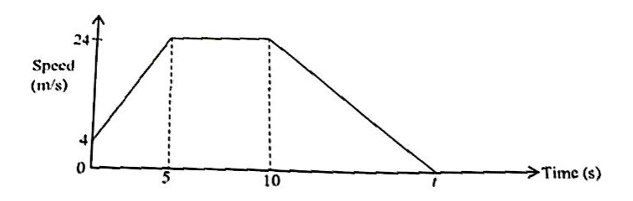
The diagram below shows the speed-time graph of a moving object.
(a) Find the acceleration of the object when t = 3.
- A4m/s2
- B20m/s2
- C5m/s2
- D3m/s2
40.
The diagram below shows the speed-time graph of a moving object.
(b) Given that the object decelerates at 2m/s2, find the value of t,
- A17 seconds
- B22 seconds
- C20 seconds
- D12 seconds
41.
The diagram below shows the speed-time graph of a moving object.
(c) Calculate the average speed of the object in the first 10 seconds of the journey.
- A18m/s
- B24m/s
- C19m/s
- D14m/s
42.
The functions f and g are defined by f(x) = x + 92 and g(x) = x − 2. Find f-1(x).
- Ax − 92
- B2x + 9
- C2x − 9
- Dx2 − 9
43.
The functions f and g are defined by f(x) = x + 92 and g(x) = x − 2. Find fg(x).
- Ax + 52
- Bx + 72
- Cx + 7
- Dx + 112
44.
The functions f and g are defined by f(x) = x + 92 and g(x) = x − 2. Find fg(−5).
- A0
- B2
- C−1
- D1