
Save as PDF or print — the answers and worked solutions live online, where your work gets marked free.
Examinations Council of Zambia — past paper
ECZ 2021 O-Level Paper 2 — Mathematics
12 questions · downloaded from g12titan.com, where this paper is marked free online

1.
(a)
Simplify a - 12a2 - 144. [2]
(b)
A box contains 3 black and 2 white marbles of the same size. A marble is taken out at random from the box and not replaced. A second marble is then drawn. Calculate the probability that both marbles are
(b(i))
white, [2]
(b(ii))
of different colours. [3]
2.
(a)
Evaluate ∫1-1 (1 - 4x + 3x2) dx. [3]
(b)
At a certain secondary school, all the learners in Grade twelve take at least one of the following optional subjects: French (F), Home Economics (HE) and Geography (G). 20 learners take French only, 25 learners take Home Economics only and 22 learners take Geography only. Furthermore, 9 learners take French and Geography, 12 learners take French and Home Economics, 15 learners take Geography and Home Economics and 4 learners take all the three subjects.
(b(i))
Illustrate this information in a Venn diagram. [2]
(b(ii))
How many Grade twelve learners
(b(ii)(a))
are at this school, [1]
(b(ii)(b))
take Home Economics and Geography but not French, [1]
(b(ii)(c))
take two optional subjects only? [1]
3.
(a)
The second and the fifth terms of a geometric progression are 16 and 2 respectively. Find
(a(i))
the common ratio and first term, [3]
(a(ii))
the 12th term, [2]
(a(iii))
the sum of the first 10 terms. [2]
(b)
Express 51 - x - 3x - 2 as a single fraction in its lowest terms. [3]
4.
(a)
Solve the equation 2x2 - 13x + 14 = 0, giving your answers correct to 2 decimal places. [5]
(b)
In the diagram below, OA = 4a, OB = 3b, M is the midpoint of AB and OB = 3BD.
Express in terms of a and/or b
(b(i))
AB, [1]
(b(ii))
OM, [1]
(b(iii))
AD, [1]
(b(iv))
MD. [2]
5.
(a)
Given that matrix P = 122-x,
(a(i))
find the value of x for which the determinant of P is -3, [2]
(a(ii))
hence, find the inverse of P. [2]
(b)
Study the flowchart below.
Write a pseudocode corresponding to the flowchart programme. [5]
6.
(a(i))
Construct triangle ABC in which AB = 6 cm, BC = 9 cm and AC = 5 cm. [1]
(a(ii))
Measure and write the size of angle ABC. [1]
(b)
Within the triangle ABC, draw the locus of points which are
(b(i))
equidistant from A and C, [1]
(b(ii))
3 cm from A, [1]
(b(iii))
equidistant from AC and BC. [2]
(c)
A point P, within triangle ABC, is such that it is less than or equal to 3 cm from A, nearer to BC than AC and closer to A than to C. Indicate clearly by shading, the region in which P must lie. [2]
7.
(a)
The points P, Q, R and T are on the surface of the earth as shown in the diagram below. (Take π = 3.142 and R = 3 437 nm)
(a(i))
Determine the difference in longitudes between points Q and R. [2]
(a(ii))
Find the length of the circle of latitude 40° S in nautical miles. [2]
(a(iii))
Calculate the distance TR in nautical miles. [2]
(b)
The diagram below shows a cone. The shaded part is the thickness of the cone. The internal volume is 34 650 cm3. The internal base area is 3 850 cm2. [Take π = 3.142]
(b(i))
Calculate the internal height (h) and radius (r). [4]
(b(ii))
Given that the cone is 0.7 cm thick, calculate the external volume of the cone. [2]
8.
(a)
A point C is mapped onto a point C'(-2, 3) by a single transformation whose matrix is 1-201.
(a(i))
Find the coordinates of the point C. [2]
(a(ii))
Describe fully the transformation represented by the matrix above. [3]
(b)
Triangle PQR with vertices P(2, 2), Q(2, 0) and R(0, 1) is mapped onto triangle P'Q'R' whose vertices are P'(-4, 2), Q'(-4, 0) and R'(0, 1).
(b(i))
Find the matrix which represents this transformation. [3]
(b(ii))
Hence, describe fully the transformation. [3]
(c)
F is a transformation represented by the k00k. The images of A(2, 2) and B(-2, 4) under F are A'(5, 5) and B'(-5, 10) respectively. Find the value of k. [1]
9.
A traditional drinks dealer stocks two brands of drinks, brand A and brand B, both of which are produced in bottles of the same size. He wishes to order fresh supplies and finds that he has room for up to 900 bottles. He knows that brand A is more popular and so decides to order at least twice as many bottles of brand A as brand B. He wishes, however, to have at least 100 bottles of brand B and not more than 700 bottles of brand A.
(a)
Let x be the number of bottles of brand A and y the number of bottles of brand B. Write four inequalities to represent the information above. [4]
(b)
Using a scale of 2 cm to represent 100 bottles on each axis, draw x and y axes for 0 ≤ x ≤ 900 and 0 ≤ y ≤ 900 respectively and shade the unwanted region to indicate clearly the region where the solution of the inequalities lie. [4]
(c)
Given that the profit on a bottle of brand A is K3.00 and on a bottle of brand B is K2.00, find
(c(i))
the number of bottles of each brand that gives maximum profit, [2]
(c(ii))
the maximum profit. [2]
10.
The table below shows the heights of trees in a plantation. Height in cm0<x≤1010<x≤2020<x≤3030<x≤4040<x≤5050<x≤6060<x≤70Frequency30702002001603010
(a)
Calculate the standard deviation. [6]
(b(i))
Using the table above, copy and complete the relative cumulative frequency table below. Height in cm≤0≤10≤20≤30≤40≤50≤60≤70Cumulative frequency030100300500660690700Relative cumulative frequency0.000.040.140.431.00 [1]
(b(ii))
Using a scale of 2 cm to represent 10 units on the x-axis for 0 ≤ x ≤ 70 and 2 cm to represent 0.1 units on the y-axis for 0.00 ≤ y ≤ 1.00, draw a smooth relative cumulative frequency curve. [3]
(b(iii))
Showing your method clearly, use your graph to estimate the 80th percentile. [2]
11.
(a)
The values of x and y are connected by the equation y = x(x2 - 4). Some corresponding values of x and y are given in the table below. x-3-2-10123y-15r30-3015
(a(i))
Calculate the value of r. [1]
(a(ii))
Using a scale of 2 cm to represent 1 unit on the x-axis for -3 ≤ x ≤ 3 and 2 cm to represent 10 units on the y-axis for -20 ≤ y ≤ 20, draw the graph of y = x(x2 - 4). [3]
(a(iii))
Use your graph to solve the equations
(a(iii)(a))
x(x2 - 4) = 0, [2]
(a(iii)(b))
x(x2 - 4) = 2. [3]
(b)
Find the equation of the normal to the curve y = x2 - x + 4 at the point (-1, 6). [3]
12.
(a)
The diagram below shows triangle ABC in which AB = 11.5 m, BC = 7.2 m and AC = 15.1 m.
Calculate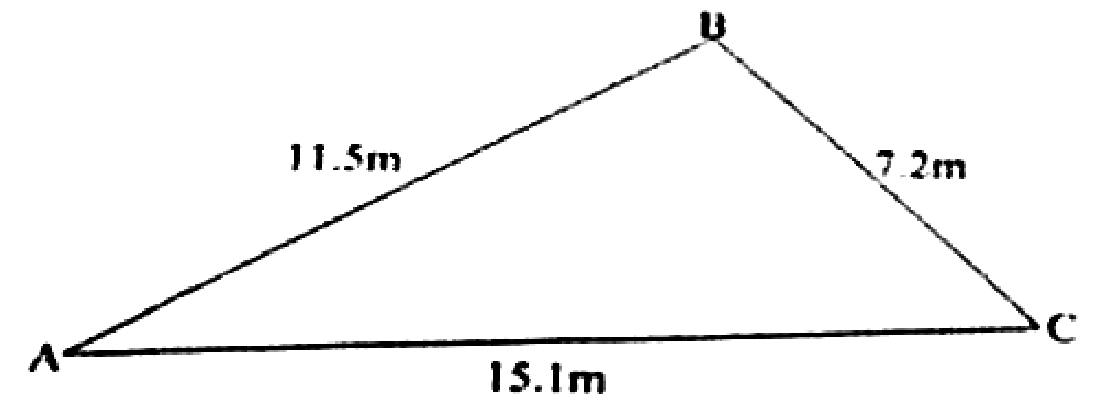
(a(i))
angle ABC, [5]
(a(ii))
the area of triangle ABC, [2]
(a(iii))
the shortest distance from B to AC. [2]
(b)
Solve the equation 15 tan θ = 14 for 180° ≤ θ ≤ 270°. [1]
(c)
Simplify 39x328y4 ÷ 65x556y5. [2]