
Save as PDF or print — the answers and worked solutions live online, where your work gets marked free.
Examinations Council of Zambia — past paper
ECZ 2022 GCE Paper 2 — Mathematics
12 questions · downloaded from g12titan.com, where this paper is marked free online

1.
(a)
Express 6x - 2 - 2x - 4 as a single fraction in its lowest terms. [3]
(b)
Evaluate ∫2-3 (4 - 3x2) dx. [3]
2.
(a)
Simplify 4p3q ÷ p2 q6 × pq2. [2]
(b)
The first three terms of a geometric progression are 3, 6 and 12 respectively. Find the
(b(i))
nth term, [2]
(b(ii))
geometric mean of 96 and 384, [2]
(b(iii))
sum of the first 8 terms of the progression. [3]
3.
(a)
In a particular locality, 25 people like walking, 22 people like running and 15 people like cycling during their morning routine exercises. 11 people like both walking and running, 9 people like both running and cycling, 7 people like both walking and cycling, 3 people like all the three activities while 7 people do not like any of the activities.
(a(i))
Draw a Venn diagram to illustrate this information. [2]
(a(ii))
How many people
(a(ii)(a))
are in this locality, [1]
(a(ii)(b))
like walking only, [1]
(a(ii)(c))
like two different activities only? [1]
(b)
The position vectors of the points A, B and C are -1-2, 36 and 918 respectively.
Show that the points A, B and C are collinear. [5]
4.
(a)
Given that matrix N = x22x6,
(a(i))
find the value of x for which the determinant of N is 8, [2]
(a(ii))
hence or otherwise, write N-1. [2]
(b)
Solve the equation 5x2 - 9x - 4 = 0, giving your answers correct to 2 decimal places. [5]
5.
Answer the whole of this question on a sheet of plain paper.
(a(i))
Construct triangle KLM in which KL = 11 cm, angle LKM = 70° and angle KLM = 50°. [1]
(a(ii))
Measure and write the length of LM. [1]
(b)
On your diagram, within triangle KLM, construct the locus of points that are
(b(i))
equidistant from K and L, [1]
(b(ii))
3 cm from KL, [1]
(b(iii))
8 cm from K. [1]
(c)
A point X within triangle KLM is such that it is 3 cm from KL and 8 cm from K. Label the point X. [1]
(d)
Another point Y is such that it is nearer to L than K, greater than or equal to 3 cm from KL and less than or equal to 8 cm from K. Indicate clearly, by shading, the region in which Y must lie. [2]
6.
(a)
A bag contains 9 identical cards, 4 of which are Kuhanjika (K) cards, 3 Landa (L) cards and the rest are Bulela (B) cards. Two cards are selected at random from the bag one after the other and not replaced.
(a(i))
Draw a tree diagram to show all the possible outcomes. [2]
(a(ii))
What is the probability that both cards selected are of the same type? [3]
(b)
Study the following pseudocode.
Construct a flowchart corresponding to the pseudocode above. [5]
7.
Answer the whole of this question on a sheet of graph paper.
Mapulanga plans to buy planks of type A and type B for sale at his hardware shop. He has to buy up to 80 planks altogether. The number of type B planks should not be more than 3 times that of type A. He decides to buy at least 10 planks of type A and at least 20 planks of type B.
(a)
Given that x represents the number of planks of type A and y the number of type B, write four inequalities which represent the above conditions. [4]
(b)
Using a scale of 2 cm to represent 10 units on both axes from 0 to 80, shade the unwanted region to indicate clearly the region where (x, y) must lie. [4]
(c)
The profit on each of type A plank is K30.00 and on each of type B plank profit is K20.00.
(c(i))
Find the number of each type that he can buy to make maximum profit. [2]
(c(ii))
Calculate this maximum profit. [2]
8.
(a)
In the diagram, XY = 6 cm, angle YXZ = 60° and angle XYZ = 80°.
Calculate the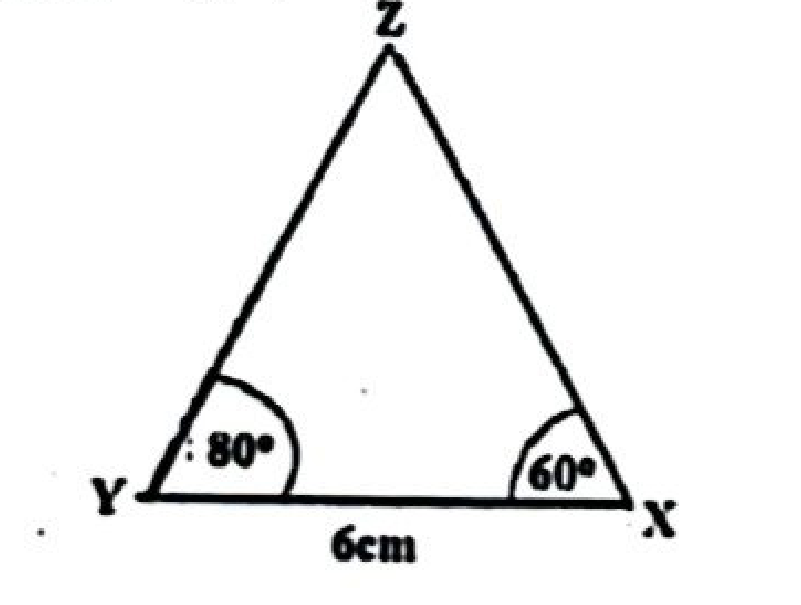
(a(i))
length of YZ, [4]
(a(ii))
area of triangle XYZ, [2]
(a(iii))
shortest distance from X to YZ. [2]
(b)
Solve the equation tan θ = 2.75 for 0° ≤ θ ≤ 360°. [2]
(c)
Simplify 1 - 4x21 + 2x. [2]
9.
(a)
In the diagram below, M, L and K are points on the surface of the earth. [π = 3.142 and R = 3 437 nm]
(a(i))
Determine the difference in longitudes between points M and K. [2]
(a(ii))
Calculate, in nautical miles, the distance between
(a(ii)(a))
M and K along latitude 80° N, [2]
(a(ii)(b))
K and L along longitude 32° E. [2]
(b)
The following diagram shows the frustum of a cone. The top and bottom diameters are 6 cm and 18 cm respectively. [Take π as 3.142]
Given that its perpendicular height is 10 cm, calculate the volume of the frustum. [6]
10.
The frequency distribution table shows the number of hours students studied on a particular day at a college.
Number of hours1234567Number of students0335621
(a)
Calculate the standard deviation. [6]
(b)
Answer this part of the question on a sheet of graph paper.
(b(i))
Using the table above, copy and complete the relative cumulative frequency table below.
Number of hours≤ 1≤ 2≤ 3≤ 4≤ 5≤ 6≤ 7Cumulative frequency03611171920Relative cumulative frequency00.150.30.55 [1]
(b(ii))
Using a scale of 2 cm to represent 1 unit on the x-axis for 0 ≤ x ≤ 7 and 2 cm to represent 0.1 units on the y-axis for 0 ≤ y ≤ 1, draw a smooth relative cumulative frequency curve. [3]
(b(iii))
Showing your method clearly, use your graph to estimate the 40th percentile. [2]
11.
Answer the whole of this question on a sheet of graph paper.
The vertices of triangle ABC are A(-3, -3), B(-1, -3) and C(-3, -1).
(a)
Using a scale of 1 cm to represent 1 unit on both axes, draw x and y axes for -6 ≤ x ≤ 8 and -4 ≤ y ≤ 8. Draw and label triangle ABC. [1]
(b)
An enlargement with centre (0, 0) and scale factor -2 maps triangle ABC onto triangle A1B1C1. Draw and label triangle A1B1C1. [2]
(c)
Triangle ABC is mapped onto triangle A2B2C2 with vertices A2(3, -3), B2(3, -1) and C2(1, -3).
(c(i))
Draw and label triangle A2B2C2. [1]
(c(ii))
Describe fully this single transformation. [3]
(d)
The 10-21 maps triangle ABC onto triangle A3B3C3. Find the coordinates of A3, B3 and C3. [3]
(e)
A stretch with x-axis as the invariant line and scale factor -1 maps triangle ABC onto triangle A4B4C4 with vertices A4(-3, 3), B4(-1, 3) and C4(-3, 1). Find the matrix of this transformation. [2]
12.
(a)
Find the equation of the tangent to the curve y = 1 + 3x - 3x2 at the point (1, 1). [3]
(b)
The following diagram shows the graph of y = 27x - x3.
(b(i))
Use the graph to solve the equations
(b(i)(a))
27x - x3 = 0, [2]
(b(i)(b))
27x - x3 = 5x + 10. [3]
(b(ii))
Calculate an estimate of the
(b(ii)(a))
gradient of the curve at the point where x = 2, [2]
(b(ii)(b))
area bounded by the curve, x-axis and x = 3. [2]