
Save as PDF or print — the answers and worked solutions live online, where your work gets marked free.
Examinations Council of Zambia — past paper
ECZ 2023 O-Level Paper 1 — Mathematics
44 questions · downloaded from g12titan.com, where this paper is marked free online

1.
The Venn diagram shows three sets P,Q and R . Use set notation to describe the shaded part.
- AP∩(Q∪R)
- BP∪(Q∩R)
- C(P∩Q)∪R
- DP′∩(Q∪R)
2.
Set A={x:1<x≤15,x is a prime number } and set B={x:0≤x<10,x is an odd number}. List the set A∩B.
- A{1,3,5,7,9}
- B{3,5,7}
- C{3,5,7,11,13}
- D{3,5,7,9}
3.
Evaluate 82713.
- A49
- B827
- C32
- D23
4.
Factorise completely 3x3 - 27x.
- A3x(x - 3)(x + 3)
- B3(x - 3)(x + 3)
- Cx(3x - 27)
- D3x(x2 - 9)
5.
Simplify 2a - 5b(a - b) + ab.
- A2a - 4ab + 5b2
- B2a - 6ab + 5b2
- C2a - 5ab + 5b2
- D2a + 6ab - 5b2
6.
The point A(-5, 3) and the point B have a midpoint (4, -2). Find the coordinates of B.
- A(9, 1)
- B(13, -7)
- C(-1, 1)
- D(-13, 7)
7.
Given that OP = 413 and the point Q is (16, 8), find |PQ|.
- A25 units
- B5 units
- C20 units
- D13 units
8.
Given that A = 124 and B = 304, find
(a) AT,
- A142
- B421
- C124
- D124
9.
Given that A = 124 and B = 304, find
(b) AB.
- A7
- B19
- C3016
- D16
10.
Given that 25 and 13 are the first and third terms of an arithmetic progression respectively, find the
(a) second term,
- A18
- B19
- C21
- D6
11.
Given that 25 and 13 are the first and third terms of an arithmetic progression respectively, find the
(b) formula for the nth term.
- A31 + 6n
- B31 - 6n
- C25 + 6n
- D25 - 6n
12.
A letter is chosen at random from the word “EXCELLENT”. What is the probability that the letter “E” is chosen?
- A13
- B38
- C29
- D19
13.
The areas of two similar shapes are in the ratio 25 : 36. If the length of the smaller shape is 2cm, find the length of the larger shape.
- A7225 cm
- B125 cm
- C6cm
- D53 cm
14.
Solve the equation 2x + 3 = 116.
- Ax = 7
- Bx = 1
- Cx = -1
- Dx = -7
15.
The diagram shows two towns A and B on the equator. A is on longitude 30°W and B is on longitude X.
The time at B is 17 05 hours when it is 14 05 hours at A. Find the longitude X.
- A15°E
- B15°W
- C75°E
- D45°E
16.
The diagram shows two towns A and B on the equator. A is on longitude 30°W and B is on longitude X.
A ship sailed due east from A to B at an average speed of 450 knots. Find the time it took the ship to travel from A to B.
- A3 hours
- B9 hours
- C60 hours
- D6 hours
17.
The functions g and h are defined by g(x) = 3x + 1 and h(x) = x - 12. Find g-1(x).
- Ax + 13
- B3x - 1
- Cx - 13
- Dx - 31
18.
The functions g and h are defined by g(x) = 3x + 1 and h(x) = x - 12. Find gh(x).
- Ax - 16
- B3x - 22
- C3x + 12
- D3x - 12
19.
The functions g and h are defined by g(x) = 3x + 1 and h(x) = x - 12. Find x if gg(x) = 22.
- A2
- B209
- C199
- D7
20.
In a practical examination, Nellie recorded the volume, v, of water as 6.4 litres, correct to one decimal place. Choose the statement that gives the range within which the true volume v must lie.
- A6.4 ≤ v < 6.5
- B6.3 ≤ v < 6.5
- C6.35 ≤ v < 6.45
- D6.35 < v ≤ 6.45
21.
The actual length of the longest side of a rectangular playing field is 102m. A boy measured the same side as 99.8m. Calculate the relative error.
- A11510
- B2.299.8
- C2.2
- D51011
22.
Find ∫(x3 + 2x + 3) dx.
- A3x2 + 2 + C
- Bx44 + 2x2 + 3x + C
- Cx4 + x2 + 3x + C
- Dx44 + x2 + 3x + C
23.
In the following diagram, triangle ABC is mapped onto triangle DEF by a single transformation M.
Describe fully the transformation M.
- ATranslation by 4-4
- BRotation 180° about the origin
- CReflection in the line y = x
- DReflection in the line y = -x
24.
The diagram shows three points P, Q and R on level ground. The bearing of Q from P is 100°, the bearing of R from Q is 150° and PQ = QR.
Find
(a) angle QPR.
- A25°
- B130°
- C100°
- D50°
25.
The diagram shows three points P, Q and R on level ground. The bearing of Q from P is 100°, the bearing of R from Q is 150° and PQ = QR.
Find
(b) the bearing of P from R.
- A305°
- B330°
- C125°
- D280°
26.
In the diagram, BCE is a right angled triangle in which BC = 4cm and CE = 3cm. BE is produced to D.
Find the value of cos CED.
- A-0.8
- B-0.6
- C35
- D45
27.
The curved surface area of a cone with radius 4.2cm is 138.6cm2. Find its slant height. [π = 227]
- A10.5cm
- B21cm
- C33cm
- D4.2cm
28.
In the following diagram, A, B, C, D and E lie on the circumference of a circle centre O. BD = BE, angle CAD = 18° and angle BEC = 51°.
Find
(a) angle ADC.
- A69°
- B18°
- C90°
- D51°
29.
In the following diagram, A, B, C, D and E lie on the circumference of a circle centre O. BD = BE, angle CAD = 18° and angle BEC = 51°.
Find
(b) angle BED.
- A18°
- B90°
- C51°
- D69°
30.
In the following diagram, A, B, C, D and E lie on the circumference of a circle centre O. BD = BE, angle CAD = 18° and angle BEC = 51°.
Find
(c) angle EBC.
- A69°
- B60°
- C30°
- D51°
31.
A sugar company paid K362 400.00 as dividend for 1 200 shares.
A man had 20 shares in the company. Calculate the amount paid to him.
- AK60 400.00
- BK7 248.00
- CK6 040.00
- DK302.00
32.
Find the equation of a line parallel to the line 2x + y = 4 passing through (-5, 3).
- A2x + y = 4
- B2x - y = -7
- C2x + y = -7
- Dy = 2x - 7
33.
a varies jointly as b and the square root of c, and a = 21 when b = 5 and c = 36. Find the value of k, the constant of variation.
- A107
- B7
- C110
- D710
34.
a varies jointly as b and the square root of c, and a = 21 when b = 5 and c = 36. Find the value of a when b = 9 and c = 100.
- A630
- B63
- C90
- D70
35.
a varies jointly as b and the square root of c, and a = 21 when b = 5 and c = 36. Find the value of c when a = 70 and b = 25.
- A25
- B16
- C4
- D64
36.
In the answer space below is an incomplete simple program in pseudocode for calculating and outputting the volume, V, of a cone given the base radius r and height h. Complete the program by filling in the blank spaces with appropriate statements.
- AEnter V and h; r = Vπh
- BEnter r; V = (13) * π * r2
- CEnter r and h; V = π * r2 * h
- DEnter r and h; V = (13) * π * r2 * h
37.
Shade two more sections of the diagram below so that it has rotational symmetry of order 2.
- A

- B

- C

- D

38.
Write the three inequalities that define the unshaded region R.
- Ay ≤ 6; y ≥ x; y ≥ -2x + 6
- By ≤ 6; y ≥ x; y ≤ -2x + 6
- Cy ≥ 6; y ≥ x; y ≥ -2x + 6
- Dy ≤ 6; y ≤ x; y ≥ -2x + 6
39.
Solve the equation x2 = 4(x - 3)2.
- Ax = 2 only
- Bx = -2 or x = -6
- Cx = 6 only
- Dx = 2 or x = 6
40.
The diagram shows the sketch of the graph of y = -4x - x2 cutting the x-axis at A and B.
Find the coordinates of
(i) A.
- A(-4, 0)
- B(0, -4)
- C(4, 0)
- D(0, 0)
41.
The diagram shows the sketch of the graph of y = -4x - x2 cutting the x-axis at A and B.
Find the coordinates of
(ii) the turning point of the graph.
- A(0, 4)
- B(-2, -4)
- C(-2, 4)
- D(2, 4)
42.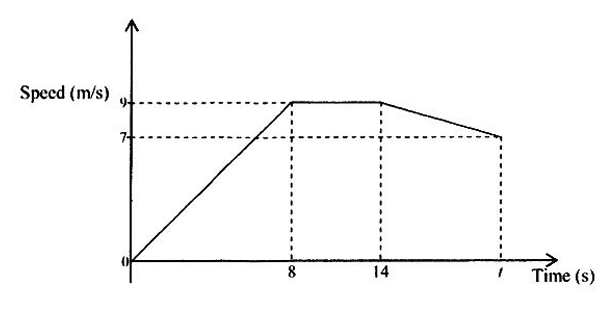
The diagram shows the speed-time graph of a car during a period of t seconds.
Find the
(a) acceleration of the car during the first 8 seconds.
- A89 m/s2
- B9m/s2
- C98 m/s2
- D72m/s2
43.
The diagram shows the speed-time graph of a car during a period of t seconds.
Find the
(b) distance covered in the first 14 seconds.
- A90m
- B36m
- C54m
- D126m
44.
The diagram shows the speed-time graph of a car during a period of t seconds.
Find the
(c) value of t if the average speed of the car is 7m/s.
- A20 seconds
- B22 seconds
- C14 seconds
- D24 seconds