
Save as PDF or print — the answers and worked solutions live online, where your work gets marked free.
Examinations Council of Zambia — past paper
ECZ 2024 O-Level Paper 1 — Mathematics
44 questions · downloaded from g12titan.com, where this paper is marked free online

1.
Shade the region P∩R'∩Q on the Venn diagram in the answer space below.
- A

- B

- C

- D

2.
Given that E={ natural numbers less than 10},A={ even numbers } and B={ prime numbers }, list A'∩B.
- A{1,3,5,7,9}
- B{3,5,9}
- C{3,5,7}
- D{3,5,7,9}
3.
Simplify 3(2x - 4) - 2(x - 1).
- A4x - 14
- B8x - 10
- C4x - 10
- D4x - 2
4.
Evaluate (-2)0 × (-2)-3.
- A18
- B-18
- C-8
- D8
5.
Factorise completely 27y2 - 3x2.
- A3(3y - x)(3y + x)
- B3(3y - x)2
- C3(9y - x2)
- D(3y - x)(3y + x)
6.
A straight line L is represented by the equation 2x - y = 5. Find the gradient of the line L.
- A-2
- B12
- C2
- D5
7.
The magnitude of PQ is 20 units. Given that OP = 50 and OQ = 17y, find the positive value of y.
- A8
- B12
- C16
- D20
8.
Given that A = 4511, find AT.
- A4511
- B4151
- C5411
- D4115
9.
Given that A = 4511 and B = x - 1120, find x if AB = 10421.
- A1
- B0
- C2
- D4
10.
Given that 99, 92 and 85 are the first three terms of an arithmetic progression, find the 6th term.
- A57
- B71
- C106
- D64
11.
Given that 99, 92 and 85 are the first three terms of an arithmetic progression, find the nth term.
- A99 - 7n
- B106 - 7n
- C106 + 7n
- D7n - 106
12.
A six-sided die is thrown once. Find the probability of getting a number which is a multiple of 3.
- A16
- B13
- C12
- D23
13.
Solve the equation (1 - 2t)2 = 25.
- At = -2 or t = 3
- Bt = 3
- Ct = -3 or t = 2
- Dt = -2 only
14.
In the following diagram, PQRSTU is a triangular prism such that PQ = QR.
State the number of planes of symmetry of the prism.
- A0
- B1
- C2
- D3
15.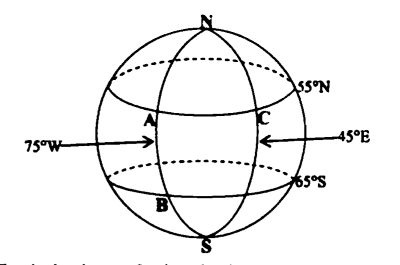
The diagram shows the positions of towns A, B and C on the earth's surface. What is the time at C when the time at A is 11:22 hours?
- A03:22 hours
- B11:22 hours
- C19:22 hours
- D23:22 hours
16.
A plane flies from A to B in 9 hours. Calculate its speed if the distance between A and B is 7200 nm.
- A720 knots
- B800 knots
- C900 knots
- D64800 knots
17.
Solve the equation 31 - 2x + 4 = 5.
- Ax = -12
- Bx = 1
- Cx = 12
- Dx = 0
18.
The diagram shows a sector AOB whose area is 231cm2 and radius 14cm. The angle subtended at the centre is θ.
Find the value of θ. [π = 227]
- A120°
- B90°
- C135°
- D270°
19.
Given that f(x) = 3x + 5 and g(x) = x + 43, find g-1(x).
- Ax + 43
- B3x - 4
- Cx - 43
- D3x + 4
20.
Given that f(x) = 3x + 5 and g(x) = x + 43, find gf(x).
- Ax - 3
- Bx + 3
- C3x + 92
- D3x + 3
21.
Given that f(x) = 3x + 5 and g(x) = x + 43, find gf(4).
- A17
- B4
- C7
- D15
22.
A container of cooking oil has a mass of 15.4 kg. Find the tolerance of the mass of the container of cooking oil.
- A0.5kg
- B0.154kg
- C0.05kg
- D0.1kg
23.
A container of cooking oil has a mass of 15.4 kg. Write down the relative error of the mass of the container of cooking oil as a fraction in its simplest form.
- A1154
- B5154
- C120
- D1308
24.
The diagram in the answer space shows triangle ABC with vertices A(2, 3), B(4, 2) and C(4, 4). Triangle ABC is mapped onto triangle A1B1C1 under a reflection in the line x = 6. Draw triangle A1B1C1 on the diagram in the answer space.
- AA1(10, -3), B1(8, -2), C1(8, -4)
- BA1(6, 3), B1(8, 2), C1(8, 4)
- CA1(4, 3), B1(2, 2), C1(2, 4)
- DA1(10, 3), B1(8, 2), C1(8, 4)
25.
The equation of a curve is y = x - 2x2 + 1x3. Find dydx.
- A1 - 4x - 3x4
- B1 - 2x - 3x4
- C1 - 4x + 3x4
- Dx - 4x - 3x4
26.
It is given that a varies as b and inversely as the square of c, and a = 9 when b = 12 and c = 2. Find the value of k, the constant of variation.
- A3
- B27
- C13
- D9
27.
It is given that a varies as b and inversely as the square of c, and a = 9 when b = 12 and c = 2. Find the value of a when b = 16 and c = 4.
- A48
- B3
- C12
- D1
28.
It is given that a varies as b and inversely as the square of c, and a = 9 when b = 12 and c = 2. Find the values of c when b = 25 and a = 3.
- Ac = 25 or c = -25
- Bc = 5 or c = -5
- Cc = 5
- Dc = 15 or c = -15
29.
In the following diagram, P, Q and R are points on the circumference of the circle, centre O. ARB is a tangent to the circle at R, angle ABP = 15° and angle ARP = 44°.
Find
(a) angle OPR.
- A90°
- B46°
- C29°
- D44°
30.
In the following diagram, P, Q and R are points on the circumference of the circle, centre O. ARB is a tangent to the circle at R, angle ABP = 15° and angle ARP = 44°.
Find
(b) angle PQR.
- A44°
- B29°
- C136°
- D46°
31.
In the following diagram, P, Q and R are points on the circumference of the circle, centre O. ARB is a tangent to the circle at R, angle ABP = 15° and angle ARP = 44°.
Find
(c) angle BPR.
- A15°
- B46°
- C44°
- D29°
32.
A company declares a dividend of 8%. Mary owns 1 300 shares of value K75.00 each. How much dividend does she receive?
- AK97 500.00
- BK780.00
- CK7 800.00
- DK1 300.00
33.
The point (-1, -4) is the midpoint of the line PQ. Given that P is the point (2, -3), find the coordinates of the point Q.
- A(-4, -5)
- B(0, -7)
- C(4, 5)
- D(-3, -1)
34.
In the following diagram, A, B and C are three points on level ground. A is due north of C, angle ABC = 50° and angle ACB = 60°.
Calculate the bearing of
(a) A from B.
- A290°
- B070°
- C110°
- D050°
35.
In the following diagram, A, B and C are three points on level ground. A is due north of C, angle ABC = 50° and angle ACB = 60°.
Calculate the bearing of
(b) B from A.
- A070°
- B290°
- C110°
- D050°
36.
Two solid cylinders are geometrically similar. The ratio of their corresponding radii is 3 : 2. Given that the volume of the bigger cylinder is 216cm3, calculate the volume of the smaller cylinder.
- A96cm3
- B144cm3
- C32cm3
- D64cm3
37.
In the following diagram, ABCD is a trapezium. AB is parallel to CD and X is a point on CD such that AX is the perpendicular height of the trapezium. AB = a, CD = b and AX = h.
In the answer space below is an incomplete program written in pseudocode for calculating the area (A) of the trapezium. Complete the program.
- AEnter a and b; A = a * b
- BEnter a, b and h; A = 12 * (a + b) * h
- CEnter h; A = 12 * a * b
- DEnter a, b and h; A = (a + b) * h
38.
Write the three inequalities that define the unshaded region R in the diagram below.
- Ay ≤ 4; y ≤ x + 4; y ≥ -2x - 8
- By ≤ 4; y ≥ x + 4; y ≤ -2x - 8
- Cy ≤ 4; y ≥ x + 4; y ≥ -2x - 8
- Dy ≥ 4; y ≥ x + 4; y ≥ -2x - 8
39.
A straight line L is perpendicular to the line y = 3x + 4. Given that line L passes through the point (3, a) and has 3 as its y intercept, find the value of a.
- A-2
- B4
- C3
- D2
40.
The diagram shows a sketch of a curve passing through A(-5, 0) and B(-1, 0).
Find the
(i) equation of the curve.
- Ay = (x + 5)(x + 1)
- By = -(x - 5)(x - 1)
- Cy = x2 + 6x + 5
- Dy = -(x + 5)(x + 1)
41.
The diagram shows a sketch of a curve passing through A(-5, 0) and B(-1, 0).
Find the
(ii) coordinates of the turning point of the graph.
- A(-2, 4)
- B(-3, 4)
- C(3, 4)
- D(-3, -4)
42.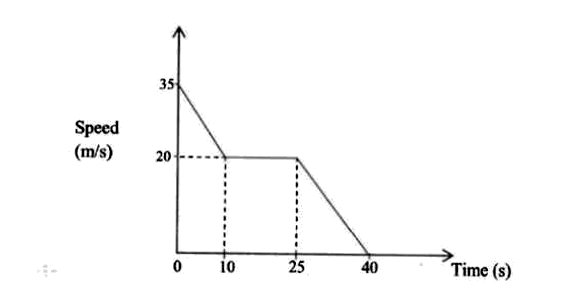
The following diagram is a speed-time graph of a particle moving in a straight line. The particle decelerates uniformly from a speed of 35m/s to 20m/s in 10 seconds. It then moves at a constant speed of 20m/s for 15 seconds before it decelerates uniformly to come to rest at the 40th second.
Calculate the
(a) retardation of the particle in the first 10 seconds.
- A1.5m/s2
- B2m/s2
- C15m/s2
- D3.5m/s2
43.
The following diagram is a speed-time graph of a particle moving in a straight line. The particle decelerates uniformly from a speed of 35m/s to 20m/s in 10 seconds. It then moves at a constant speed of 20m/s for 15 seconds before it decelerates uniformly to come to rest at the 40th second.
Calculate the
(b) speed of the particle when t = 31 seconds.
- A12m/s
- B20m/s
- C15m/s
- D8m/s
44.
The following diagram is a speed-time graph of a particle moving in a straight line. The particle decelerates uniformly from a speed of 35m/s to 20m/s in 10 seconds. It then moves at a constant speed of 20m/s for 15 seconds before it decelerates uniformly to come to rest at the 40th second.
Calculate the
(c) average speed of the particle for the whole journey.
- A17.5m/s
- B145m/s
- C20m/s
- D18.125m/s