
Save as PDF or print — the answers and worked solutions live online, where your work gets marked free.
Examinations Council of Zambia — past paper
ECZ 2024 O-Level Paper 2 — Mathematics
12 questions · downloaded from g12titan.com, where this paper is marked free online

1.
(a)
Simplify 15a2 b7cd2 ÷ 5a3 b221c2 d3. [2]
(b)
Solve the equation 2x2 - x - 2 = 0, giving your answers correct to 2 decimal places. [5]
2.
(a)
Two boxes A and B contain balls of the same size. Box A contains 2 green balls and 3 blue balls while Box B contains 4 green balls and 2 blue balls. If one ball is selected at random from each box, what is the probability that both balls selected are
(a(i))
blue, [2]
(a(ii))
of different colours? [3]
(b)
On a particular day at a school with 50 Grade 12 learners, 33 collected Biology textbooks, 24 collected Mathematics textbooks and 23 collected History textbooks from the school library. 13 learners collected both Biology and Mathematics textbooks, 16 collected both Mathematics and History textbooks, 15 collected both Biology and History textbooks and 10 collected all the three types of textbooks.
(b(i))
Illustrate this information in a Venn diagram. [2]
(b(ii))
How many learners collected
(b(ii)(a))
none of the textbooks, [1]
(b(ii)(b))
one type of textbook only, [1]
(b(ii)(c))
two types of textbooks only? [1]
3.
(a)
The following program is written in the form of pseudocode.
Start
Enter r, s
IF s < r THEN
Print 'error, s is not valid'
ELSE A = π*r*s
END IF
Print A
Stop
Draw a flowchart corresponding to the pseudocode above. [5]
(b)
In the diagram, EFG is a triangle in which EH = 4a, EF = 4b, FJ : JG = 1 : 3 and H is the midpoint of EG. FH and EJ meet at P.
(b(i))
Express in terms of a and/or b
(b(i)(a))
FH, [1]
(b(i)(b))
FG, [1]
(b(i)(c))
EJ. [1]
(b(ii))
Given that FP = kFH, show that EP = 4ka + 4(1 - k)b. [2]
4.
(a)
Given that matrix P = 3-1-42, find its
(a(i))
determinant, [2]
(a(ii))
inverse. [2]
(b)
Given the geometric progression 10, 30, 90, ..., find the
(b(i))
10th term, [2]
(b(ii))
sum of the first 6 terms, [3]
(b(iii))
geometric mean of 2 430 and 21 870. [2]
5.
(a)
Construct a quadrilateral PQRS in which PQ = 8 cm, angle QPS = 110°, angle PQR = 88°, PS = 7 cm and QR = 10 cm. [1]
(b)
Measure and write the length of RS. [1]
(c)
Within the quadrilateral PQRS, construct the locus of points which are
(c(i))
6 cm from QR, [1]
(c(ii))
equidistant from PS and RS. [2]
(d)
A point M, within the quadrilateral PQRS, is such that it is 6 cm from QR and equidistant from PS and RS. Label the point M. [1]
(e)
Another point N, within the quadrilateral PQRS, is such that it is less than or equal to 6 cm from QR and nearer to PS than RS. Indicate, by shading, the region in which N must lie. [2]
6.
(a)
Evaluate ∫31 (4x3 - 3x2 + 2) dx. [3]
(b)
Express 1x - 1 - 102x + 1 as a single fraction in its simplest form. [3]
7.
(a)
The diagram is a rectangular based right pyramid.
Given that PQ = 8 cm, QR = 6 cm and SV = PV = QV = RV = 13 cm, calculate the
(a(i))
perpendicular height, MV, of the pyramid, [3]
(a(ii))
volume of the pyramid. [3]
(b)
The diagram shows the points R, Q, P and T on the surface of the earth.
[Take π = 3.142 and R = 3 437 nm]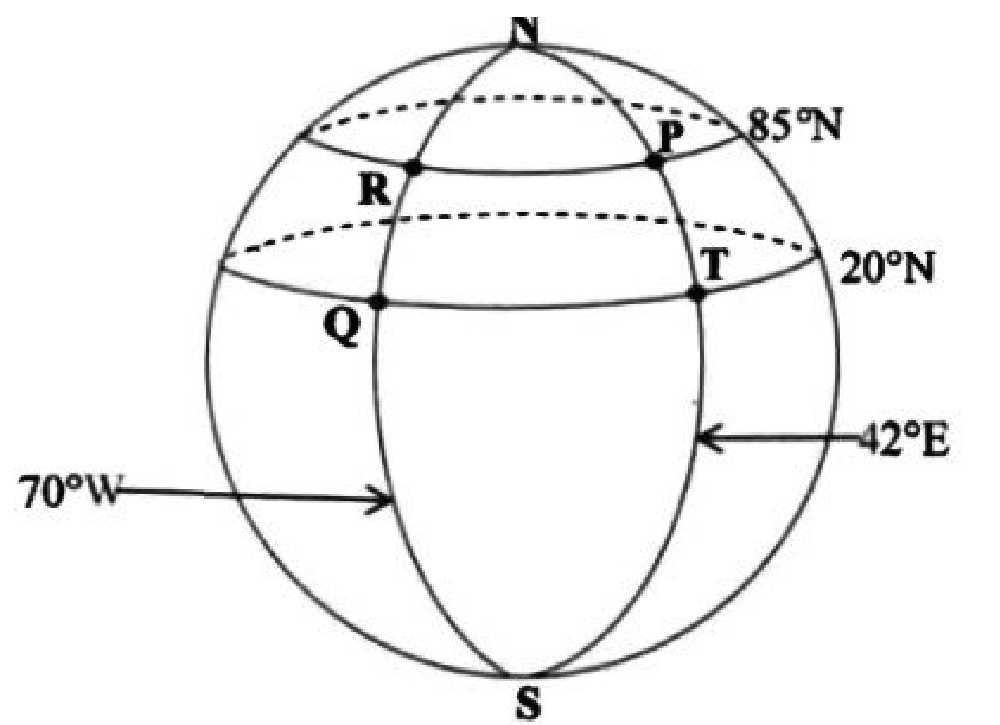
(b(i))
Find the difference in longitudes between points Q and T. [2]
(b(ii))
Calculate, in nautical miles, the distance between
(b(ii)(a))
R and P along latitude 85° N, [2]
(b(ii)(b))
P and T along longitude 42° E. [2]
8.
The table shows the time, in minutes, taken by 80 learners to complete a task in a Science experiment. Time in minutes0<x≤22<x≤44<x≤66<x≤88<x≤1010<x≤12Number of learners5152520105
(a)
Calculate the standard deviation. [6]
(b(i))
Using the table above, copy and complete the cumulative frequency table below. Time in minutes≤0≤2≤4≤6≤8≤10≤12Number of learners052045 [1]
(b(ii))
Using a scale of 2 cm to represent 2 units on the x-axis for 0 ≤ x ≤ 12 and 2 cm to represent 10 units on the y-axis for 0 ≤ y ≤ 80, draw a smooth cumulative frequency curve. [3]
(b(iii))
Showing your method clearly, use your graph to estimate the semi-interquartile range. [2]
9.
A businessman intends to make two types of products, A and B for sale. The cost of making product A is K60.00 and the cost of making product B is K30.00. The businessman has K3 000.00 to spend on the products. He decides to produce at least 20 of product A and at least 10 of product B.
(a)
Let x be the number of product A and y be the number of product B. Write three inequalities which represent these conditions. [4]
(b)
Using a scale of 2 cm to represent 10 units on each axis, draw the x-axis for 0 ≤ x ≤ 60 and y-axis for 0 ≤ y ≤ 100 respectively and shade the unwanted region to show clearly the region in which the solution of the inequalities lie. [4]
(c)
The profit on the sale of product A is K80.00 and profit on the sale of product B is K50.00. How many products of each type can he make to maximise profit? [2]
(d)
Calculate the maximum profit. [2]
10.
Study the following diagram and answer the questions that follow.
(a)
A clockwise rotation maps triangle JKL onto triangle ABC. Find the centre and angle of this transformation. [2]
(b)
A transformation with matrix -200-2 maps triangle JKL onto triangle XYZ, not shown on the diagram. Find the
(b(i))
scale factor of this transformation, [1]
(b(ii))
coordinates of X, Y and Z. [3]
(c)
Triangle JKL is mapped onto triangle PQR by a stretch. Find the matrix which represents this transformation. [3]
(d)
Describe fully a single transformation which maps triangle JKL onto triangle DEF. [3]
11.
(a)
The values of x and y are connected by the equation y = x3 - 6x + 2. Some corresponding values of x and y are given in the table below. x-3-2-10123y-7672-3-2k
(a(i))
Calculate the value of k. [1]
(a(ii))
Using a scale of 2 cm to represent 1 unit on the x-axis for -3 ≤ x ≤ 3 and 2 cm to represent 5 units on the y-axis for -10 ≤ y ≤ 15, draw the graph of y = x3 - 6x + 2. [3]
(a(iii))
Use your graph to solve the equations
(a(iii)(a))
x3 - 6x + 2 = 0, [2]
(a(iii)(b))
x3 - 6x = 2. [3]
(b)
Find the equation of the normal to the curve y = x3 + 3x2 + 2 at the point (-1, 4). [3]
12.
(a)
In triangle PQR, PQ = 16.1 m, angle QPR = 42° and angle PQR = 53°.
Calculate the
(a(i))
length of QR, [4]
(a(ii))
area of triangle PQR, [2]
(a(iii))
shortest distance from R to PQ. [2]
(b)
Solve the equation 6 sin θ = -3, for 180° ≤ θ ≤ 360°. [2]
(c)
Simplify x3 - 9xx + 3. [2]