
Save as PDF or print — the answers and worked solutions live online, where your work gets marked free.
Examinations Council of Zambia — past paper
ECZ 2025 O-Level Paper 2 — Mathematics
12 questions · downloaded from g12titan.com, where this paper is marked free online

1.
(a)
Given that matrix L = -2-267 and matrix M = x-4-32, find the
(a(i))
value of x, for which the determinant of matrices L and M are equal, [2]
(a(ii))
inverse of matrix L. [2]
(b)
A boy uses two different buses to go to school. On a particular day, the probability that the first bus is late is 0.2 and the probability that the second bus is not late is 0.7. Find the probability that on this day
(b(i))
both buses are late, [2]
(b(ii))
only one bus is late. [3]
2.
(a)
Solve the equation 3x2 - 11x - 1 = 0, giving your answers correct to 2 decimal places. [5]
(b)
Find the equation of the normal to the curve y = x3 - 3x2 + 3x - 6, at the point (2, -4). [3]
3.
(a)
Simplify 88r3 s2 t28p3 q3 ÷ 22r3 s2 t348p3 q3. [2]
(b)
For the geometric progression 189, 63, 21, ..., find the
(b(i))
common ratio, [2]
(b(ii))
5th term, [2]
(b(iii))
sum to infinity. [3]
4.
A certain school offers French, Chinese and Japanese classes. A group of students was asked which language they had studied. The following Venn diagram shows the results.
(a)
How many students studied
(a(i))
at least one language, [2]
(a(ii))
French or Chinese but not Japanese, [1]
(a(iii))
one of the languages only, [1]
(a(iv))
neither French, Chinese nor Japanese. [1]
(b)
Evaluate ∫1-3 (6x2 - 5x + 2) dx. [3]
5.
(a)
Study the following pseudocode.
Start
Enter r, θ
IF r < 0 THEN
Print "error, r must be positive"
ELSE A = 12 * r * r * sin θ
END IF
Print A
Stop
Draw a flowchart corresponding to the pseudocode above. [5]
(b)
Show that the points R(2, 1), A(4, 7) and B(7, 16) are collinear. [5]
6.
(a)
Construct triangle PQR in which PQ = 8 cm, angle QPR = 50° and angle PQR = 70°. [1]
(b)
Measure and write the length of PR. [1]
(c)
Within triangle PQR, draw the locus of points which are
(c(i))
3 cm from PQ, [1]
(c(ii))
6 cm from R, [1]
(c(iii))
equidistant from P and Q. [2]
(d)
A point L within the triangle PQR, is such that it is less than or equal to 3 cm from PQ, less than or equal to 6 cm from R and nearer to P than to Q. Indicate, by shading, the region in which L must lie. [2]
7.
A man wishes to bake two types of scones, type P and type Q for sale. He must bake at least 10 scones of type P and at least 20 scones of type Q. The number of scones of type Q must not exceed twice the number of scones of type P. He intends to bake not more than 60 scones altogether.
(a)
Given that x represents the number of scones of type P and y represents the number of scones of type Q, write four inequalities which satisfy the conditions above. [4]
(b)
Using a scale of 2 cm to represent 10 units on each axis, draw x and y axes for 0 ≤ x ≤ 60 and 0 ≤ y ≤ 60 respectively and shade the unwanted region to show clearly where the solution of the inequalities lie. [4]
(c)
If the profit on the sale of type P scones is K15.00 and profit on type Q is K20.00, find the number of each type of scones he should bake in order to make maximum profit. [2]
(d)
Calculate this estimate of the maximum profit. [2]
8.
(a)
The diagram shows a triangular piece of land LMN in which LM = 23.7 m, MN = 16.6 m and angle LMN = 106°.
Calculate the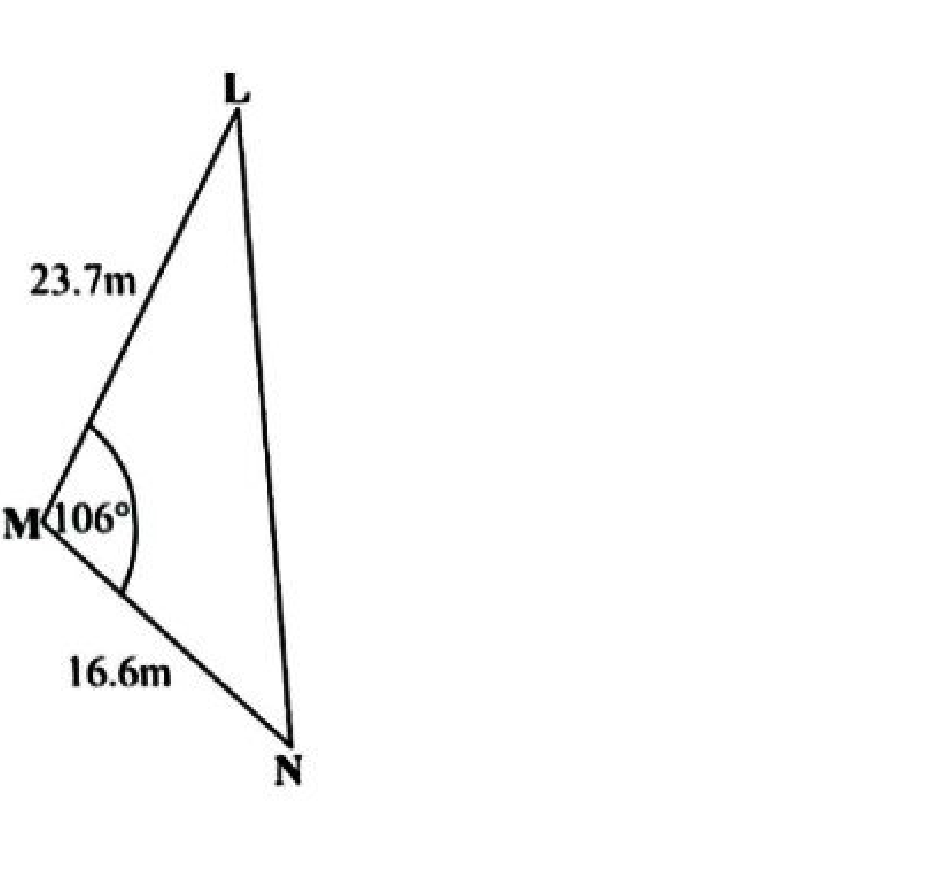
(a(i))
distance LN, [5]
(a(ii))
area of triangle LMN, [2]
(a(iii))
shortest distance from M to LN. [2]
(b)
Solve the equation 7 cos θ = 4 for 180° ≤ θ ≤ 360°. [1]
(c)
Simplify 216 - 6x26 + x. [2]
9.
(a)
The diagram shows the graph of y = x3 - 2x2 - 11x + 12.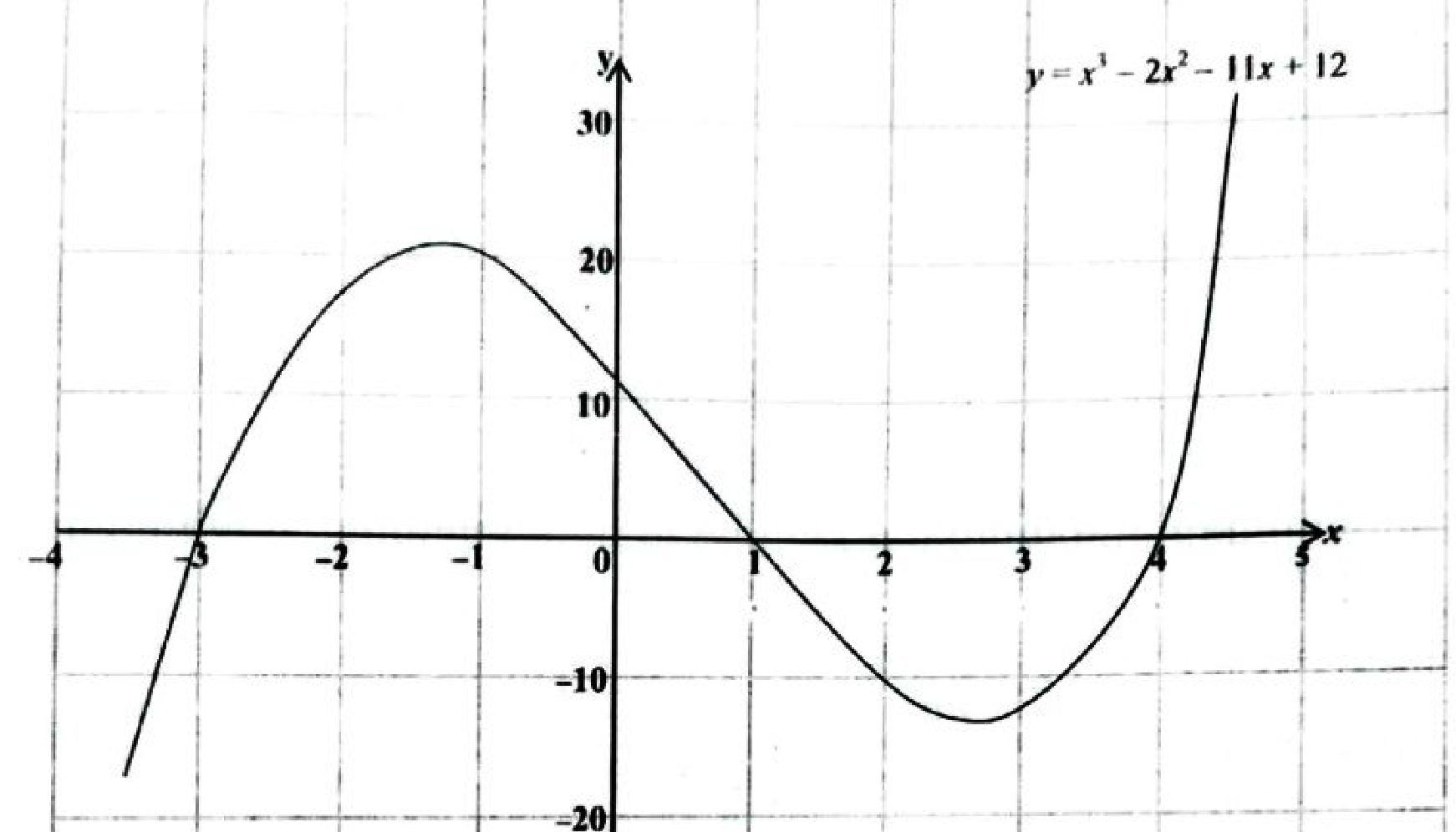
(a(i))
Use the graph to solve the equations
(a(i)(a))
x3 - 2x2 - 11x + 12 = 0, [2]
(a(i)(b))
x3 - 2x2 - 11x + 12 = 4x + 10. [2]
(a(ii))
Find the gradient of the curve at the point where x = -2. [2]
(a(iii))
Calculate the area bounded by the curve, x = -3, x = 0 and y = 0. [3]
(b)
Express 33p - 5 + 7p + 1 as a single fraction in its lowest terms. [3]
10.
The frequency table shows the heights of mango seedlings measured and recorded on a particular day. Height in cm0<x≤44<x≤88<x≤1212<x≤1616<x≤2020<x≤2424<x≤28Frequency21120243184
(a)
Calculate the standard deviation. [6]
(b(i))
Using the information in the frequency table, complete the following relative cumulative frequency table. Height in cm≤0≤4≤8≤12≤16≤20≤24≤28Cumulative frequency021333578896100Relative cumulative frequency00.020.131 [1]
(b(ii))
Using a scale of 2 cm to represent 4 units on the x-axis and 2 cm to represent 0.1 units on the y-axis, draw a smooth relative cumulative frequency curve. [3]
(b(iii))
Showing your method clearly, use your graph to estimate the 60th percentile. [2]
11.
(a)
The diagram shows a bigger cone ABCDE with perpendicular height 18 cm from which a smaller cone BCD was cut to make a bucket ABDE. AE = 12 cm and CF = 6 cm. [Take π as 3.142]
Calculate the
(a(i))
radius FD, [2]
(a(ii))
volume of the bucket ABDE. [4]
(b)
In the diagram, A, B, C and D are points on the surface of the earth.
[Take π as 3.142 and R = 3 437 nm]
Calculate the
(b(i))
length of the circle of latitude 52° N, [2]
(b(ii))
distance BC along the longitude 76° E, [2]
(b(iii))
distance DC along the circle of latitude 78° S. [2]
12.
The vertices of a quadrilateral ABCD are A(1, 1), B(1, 3), C(3, 3) and D(4, 1) and the vertices of a quadrilateral A1B1C1D1 are A1(1, -2), B1(1, -6), C1(3, -6) and D1(4, -2).
(a)
Using a scale of 1 cm to represent 1 unit on each axis for -9 ≤ x ≤ 6 and -9 ≤ y ≤ 6, draw and label quadrilaterals ABCD and A1B1C1D1. [2]
(b)
Describe fully the transformation which maps quadrilateral ABCD onto quadrilateral A1B1C1D1. [3]
(c)
A rotation of 90° anti-clockwise about the origin maps quadrilateral ABCD onto quadrilateral A2B2C2D2.
(c(i))
Draw and label quadrilateral A2B2C2D2. [1]
(c(ii))
Find the matrix of this transformation. [2]
(d)
An enlargement maps quadrilateral ABCD onto quadrilateral A3B3C3D3 with vertices A3(-2, -2), B3(-2, -6), C3(-6, -6) and D3(-8, -2).
(d(i))
Draw and label quadrilateral A3B3C3D3. [1]
(d(ii))
Find the centre and scale factor of the enlargement. [3]